Christmas Story
Ellis’s Moon Wish
Ellis hopes for a telescope so he and his little sister Nina can look at the moon together on Christmas Eve. But with the sky covered in clouds, the siblings turn to paper, a flashlight, and their imaginations while they wait by the window.
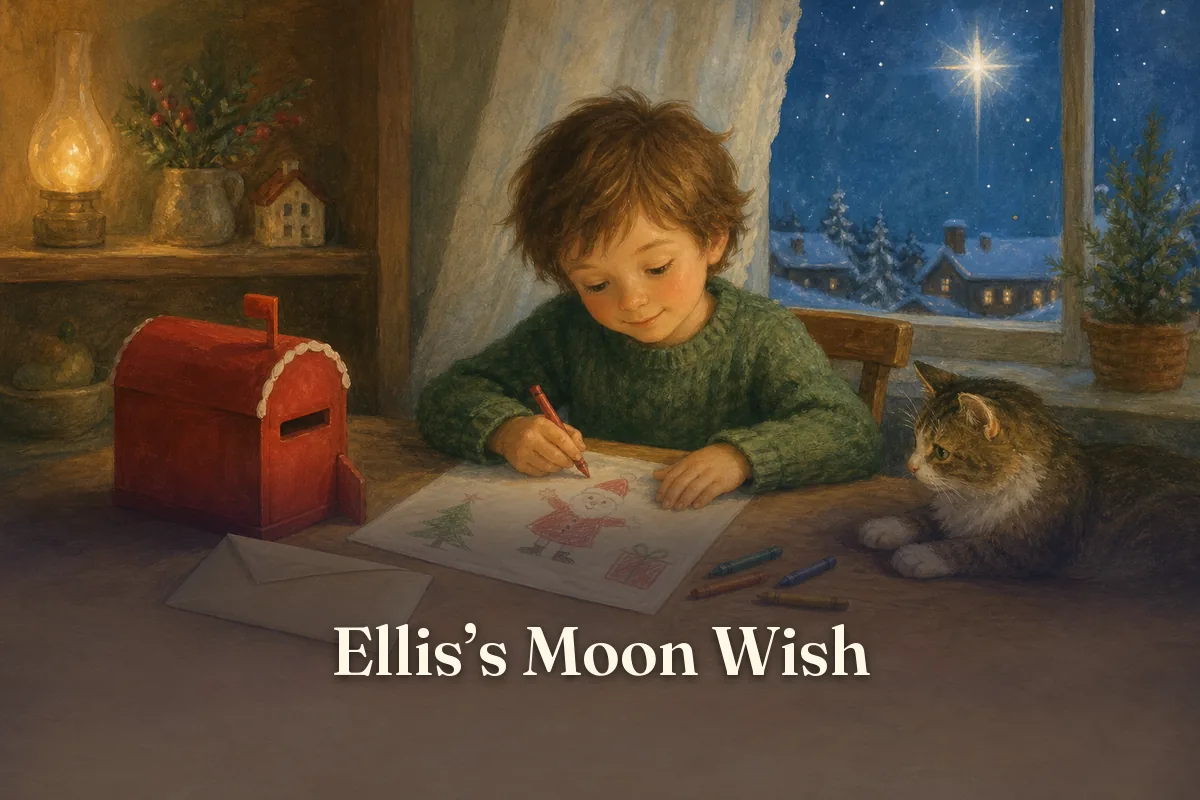
Ellis drew a telescope beside his name on his Christmas wish list. Then he sketched a tiny moon in the corner of the page, with a smiley face tucked inside one crater.
“I want to see the moon close up,” he told his little sister, Nina. “Maybe I could see every bump and shadow.”
Nina leaned over his shoulder. “Would you let me look, too?”
“Of course.” Ellis added a star beside the telescope. “That’s my wish for you: to see the moon with me on Christmas Eve.”
Their small backyard waited beyond the window. A string of little lights glowed along the fence, and a bare tree made crooked shadows on the garden path. The sky was cloudy from one side to the other. No moon showed anywhere.
Ellis folded his wish list into a letter for Santa. He wrote, Dear Santa, I hope for a telescope so Nina and I can look at the moon together. He paused, listening to the quiet house and the soft tick of the clock. Then he added, We’ll be watching from the window.
Nina brought two mugs of warm milk to the window seat. They sat shoulder to shoulder, peering out over the garden.
“Maybe the moon is hiding behind that big cloud,” she whispered.
“Or that one,” Ellis said, pointing. “It might be playing peekaboo.”
They waited. The clouds drifted, but they stayed thick and gray. Not one silver corner appeared.
Ellis pressed his nose to the glass. “I promised you a moon show.”
Nina squeezed his hand. “We can still make one.”
They hurried to the kitchen for a paper plate, a flashlight, and a sheet of white paper. Ellis cut a circle from the plate and held it in front of the flashlight. A bright spot landed on the wall.
“There!” he said. “Our moon!”
But the plate wobbled. The spot jumped up, down, and sideways. Nina moved the flashlight, and the circle stretched into a long, pale blur.
“I can’t see any craters,” Nina said.
Ellis tried again. The light slid off the wall and landed on the curtains. Their homemade moon show was not making anything easy to see.
He lowered the plate. Outside, the garden lights blinked softly beneath the cloudy sky. Ellis looked at the empty circle in his hands and began to think.
“Maybe I’m doing it wrong,” Ellis said. He turned the plate this way and that, but its bright spot kept wobbling. “A real moon doesn’t jump around like that.”
Nina tilted her head. “What if our moon doesn’t have to be real?”
Ellis looked at her. “What do you mean?”
“We could make a moon story,” Nina said. “The way you make one when you draw.”
Ellis glanced at the tiny moon on his wish list. Its smiley crater looked a little lopsided. Suddenly, that seemed like the best part.
“I don’t have to make the moon look real,” he said. “I can make a story about it for us.”
They spread the white paper on the table. Ellis cut out a big round moon. Then he cut little crater-shaped holes all the way through the paper near its edge—some round, some bumpy, and one that looked like a bite from a very hungry cookie.
Ellis held the paper moon a few inches from the wall. Nina stood behind it, holding the flashlight and aiming its beam toward the wall. The paper blocked most of the light, making a dark moon shape, but the beam shone through the holes as bright little spots.
“Try it from over there,” Ellis said.
Nina moved the flashlight to one side. The dark moon shifted, and bright spots appeared inside it where the light passed through the crater holes.
“Ooh!” Nina breathed. “That one looks like a nest.”
Ellis cut two smaller moons, each with little holes for craters. Nina moved the flashlight high, then low, while Ellis held each shape steady a few inches from the wall. The changing light made new patterns. A crater looked like a bowl. Another looked like a tiny boot print. The cookie-bite crater seemed to be winking.
“Let’s name them,” said Ellis. “You first.”
Nina pointed to the nest-shaped pattern. “The Moonbird’s Bed.”
Ellis chose the boot print. “The First Moonwalker’s Shoe.”
They took turns naming each pattern, making up a gentle tale about a moonbird who tucked stars into its nest and a moonwalker who wore very small boots.
The clouds still covered the sky beyond the window. The garden lights still shone below. But the wall now held a whole bright moon family, full of shadows and names.
Ellis returned to his wish list. Beneath the telescope, he wrote, I still hope for a telescope. And I wish for more moon stories with Nina.
He folded the note carefully and set it by the window, where Santa could find it.
The paper moons stayed on the wall, their soft edges glowing whenever Nina turned the flashlight toward them. The little room felt quiet and warm. Outside, the clouds drifted above the dark garden, and the fence lights made tiny golden dots along the path.
Nina tucked her feet under the blanket on the window seat. Ellis sat beside her, holding the last paper moon. Its largest crater made a bright spot like a round, sleepy eye.
“Do you think Santa will understand my wish?” Ellis asked.
Nina nodded. “You wrote it down. And you showed me the moon.”
Ellis smiled at the wall. He still hoped for a telescope. He could picture one resting by the window, ready for a clear night when the moon came out to visit. But tonight, the paper moons had made their own kind of sky. They were close enough to touch, and every crater had a story tucked inside it.
“Which one is your favorite?” he whispered.
“The Moonbird’s Bed,” Nina whispered back. “It looks cozy.”
Ellis pointed to a shadow near the bottom of the biggest moon. It was round at one end and narrow at the other, like a tiny sock.
“That one could be the Moonbird’s pillow,” he said.
“Or a moon muffin,” Nina said, trying not to giggle too loudly.
Ellis gave the crater a thoughtful look. “The Moonbird’s Muffin Pillow.”
They both giggled, then let the room grow quiet again. The flashlight made one last silver shape on the wall. Nina rested her head against Ellis’s shoulder, and he watched the shadows soften as she lowered the beam.
Their mother came to the doorway and smiled at the paper moons. “Time for bed, moon explorers.”
Ellis and Nina climbed under their blankets. Through the window, the cloudy sky was still hiding the moon, but Ellis did not mind. He could remember its paper circles, Nina’s bright ideas, and the patterns that changed when the flashlight moved.
As the lights went low, he and Nina whispered one last crater name together: “The Quiet Moon.” Then Ellis closed his eyes, with his wish list waiting by the window and a whole moon story glowing in his thoughts.