Fossil Story
The Fossil Picture
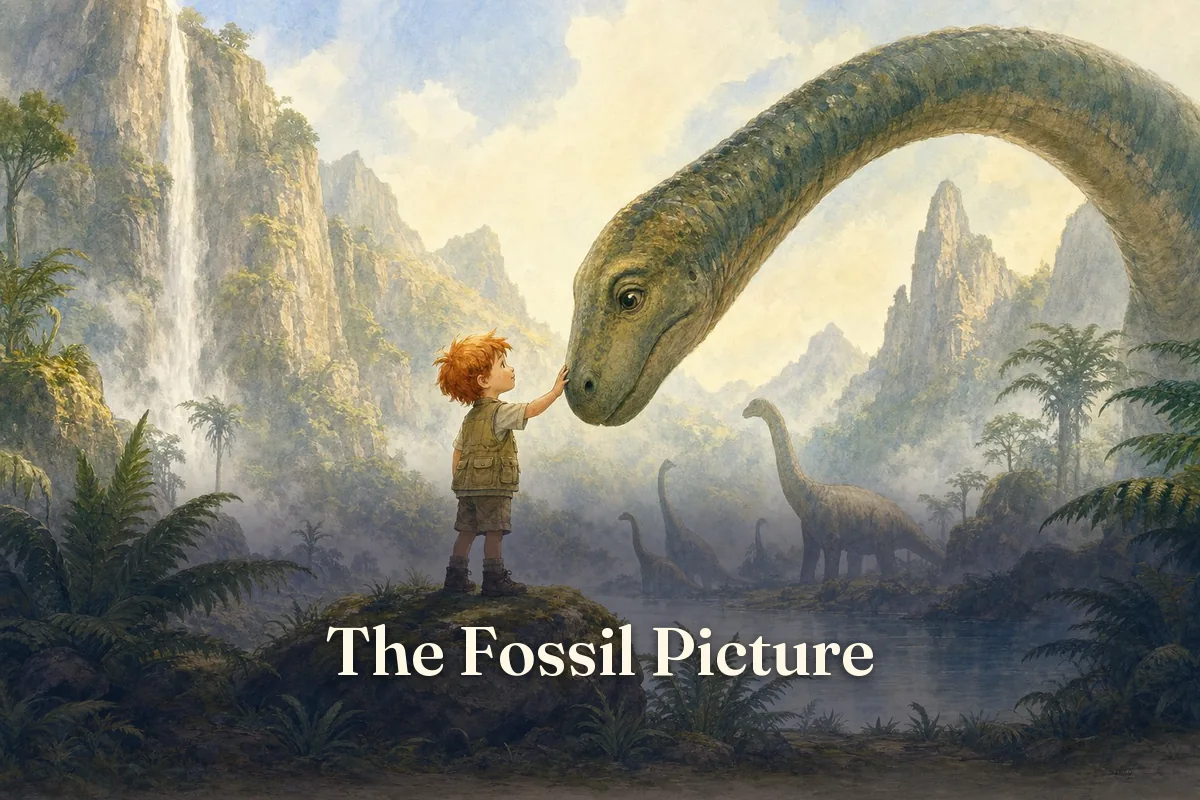
Piper and Gus are arranging fossils for their friends’ story circle, but one curved piece refuses to fit their dinosaur picture. As they look more closely at the fossils and nearby tracks, they begin to wonder whether they’ve imagined the wrong creature.
“That piece has to be the tail,” Piper said, turning the curved stone one way and then the other.
Her friend Gus leaned over the prehistoric stone shelf beside the sandy streambank. “Maybe the tail goes this way.” He turned the piece around. Its tip pointed toward a little spiral-shaped fossil.
“That looks even less like a tail,” Piper said.
On the shelf lay smooth fossil pieces they had gathered near the water: a fan-shaped shell, two bumpy stones, a long flat piece, and the spiral. Piper had arranged them into a picture of a dinosaur with a round body and a long neck. She wanted to show it at the friends’ story circle.
Gus tapped the sandy ground. “Let’s see if the tracks can help. This one is yours, and this one is mine.”
A row of old three-toed footprints pressed into the stone near the shelf. Piper placed one foot beside a print, then lifted it carefully.
“My feet are bigger,” she said. “But the old dinosaur walked this way.” She pointed along the tracks toward the stream. “Our picture could be the dinosaur who made them.”
Gus nodded. “Then it needs a tail that can swish behind it.”
Piper tried the curved piece at the back of their picture. It stuck out too far. She turned it, tucked it close, and tried again. It still didn’t look right.
“What if the dinosaur is sitting?” Gus asked.
“Dinosaurs can sit,” Piper agreed. “But this one would have a very strange tail.”
She nudged the long flat fossil into place for the dinosaur’s neck. The fan-shaped shell made a fine crest. For a moment, the picture seemed nearly ready.
Then Piper looked at the curved piece again. It refused to become a tail, no matter how carefully she turned it.
“Our story circle starts after we finish,” she said. “I really wanted to tell them about this dinosaur.”
“Maybe the picture is trying to tell us something,” Gus said. He moved the spiral a little, leaving a space beside it. “Let’s look before we decide.”
Piper bent close to the shelf. The curved stone rested between her hands. She studied its round sweep, the spiral, and the empty space beside it.
“Wait,” she said. “What if we’ve been making the wrong creature?”
Gus followed Piper’s gaze. “You mean it isn’t a dinosaur?”
“I mean, maybe this picture isn’t one,” Piper said. She set the curved piece beside the spiral. Its bend followed the open space neatly, like a curl wrapping around the shell.
Gus tilted his head. “It fits there!”
Piper slid the spiral a little closer. “The curve could be part of a big shell. Or a tail curled around it.”
“Like a sea creature,” Gus said. “One that swam through the stream when it was wide and deep.”
Piper’s eyes traveled across the scattered pieces. “Then the fan-shaped fossil could be a fin.” She moved it to one side of the spiral. “And this long piece could be another fin.”
Gus picked up the bumpy stones. “These could be eyes.” He placed one at the front of their new creature. The other rolled toward the shelf’s edge.
“Whoa!” Piper caught it with her toes and nudged it back. She and Gus both laughed.
They arranged the pieces again. The spiral became a round shell. The curved fossil fit beside it, sweeping around like a curled tail. The two flat fossils stretched out like fins, and the bumpy stones sat at the creature’s front.
Piper stepped back. “It looks like it could glide through the water.”
Gus pointed to the old tracks in the stone. “But those are dinosaur footprints. How can our sea creature belong here?”
Piper looked from the tracks to their picture. “Maybe it lived in the water long ago, when this sandy place was under a shallow sea. Later, the water went away, and dinosaurs walked here.”
Gus grinned. “So the shelf holds two stories. A sea creature’s fossil and dinosaur tracks from much later.”
Piper’s tail gave a pleased swish. “That’s better than one story.”
They shifted one fin until it lined up with the other. Piper turned the curved piece a tiny bit, and its tip nestled beside the spiral without covering it.
“There,” she said. “The creature can swim in a circle whenever it wants.”
Gus traced its shape in the air. “And the dinosaur who came later can follow those tracks right past its old home.”
Piper smiled at their finished picture. “Now we have something to share.”
Their friends gathered around the stone shelf for story circle. Some sat on the sandy bank, and some stood near the old three-toed tracks. Piper and Gus waited beside their fossil picture.
Piper pointed to the spiral first. “This is the sea creature’s shell,” she said. “It lived here when the streambank was under a shallow sea.”
“And this curved piece is its tail,” Gus added. “It curls around when the creature turns.”
One friend leaned closer. “What are the flat pieces?”
“Fins,” Piper said. “They helped it glide through the water.”
“And those bumpy stones?” another friend asked.
“Eyes,” said Gus. “It watched little fish swim by.”
Piper began the story. “One quiet morning, the sea creature swam past a sandy place. It turned in a circle, then tucked its tail close to its shell.” She moved her hand over the curved fossil without touching it. “A long, long time passed. The water went away, and the land grew dry.”
“Then a dinosaur walked here,” Gus said, pointing to the footprints. “Step, step, step. Its tracks stayed in the stone.”
Their friends listened, looking from the curled fossil to the three-toed prints. Piper and Gus took turns adding small details: a little fish hiding beneath a fin, the dinosaur pausing to drink, and the old sea creature resting quietly in its shell.
When the story ended, their friends nodded and smiled.
“I like how you changed the picture,” one friend said. “That curve really did belong beside the spiral.”
Piper glanced at Gus. “We only found out when we stopped trying to make it a tail.”
Gus gave a small bow to the fossils. “Thank you for showing us.”
The friends left the picture just as it was, resting on the stone shelf beside the stream. The fossils kept their places, and the old tracks still pointed across the ground.
As Piper and Gus walked home with their friends, they carried the sea creature’s story in their thoughts: its curled tail, its shell, and the dinosaur footsteps that came much later. By bedtime, the story had grown quiet and cozy, ready to be remembered as they settled down to sleep.