Elf Story
The Moonflower Between
Zara wants to watch the moonflower from her window, while Miles hopes to draw it from his bench. As the two elf neighbors move the pot back and forth, they begin to wonder where it belongs—and what the flower is reaching for.
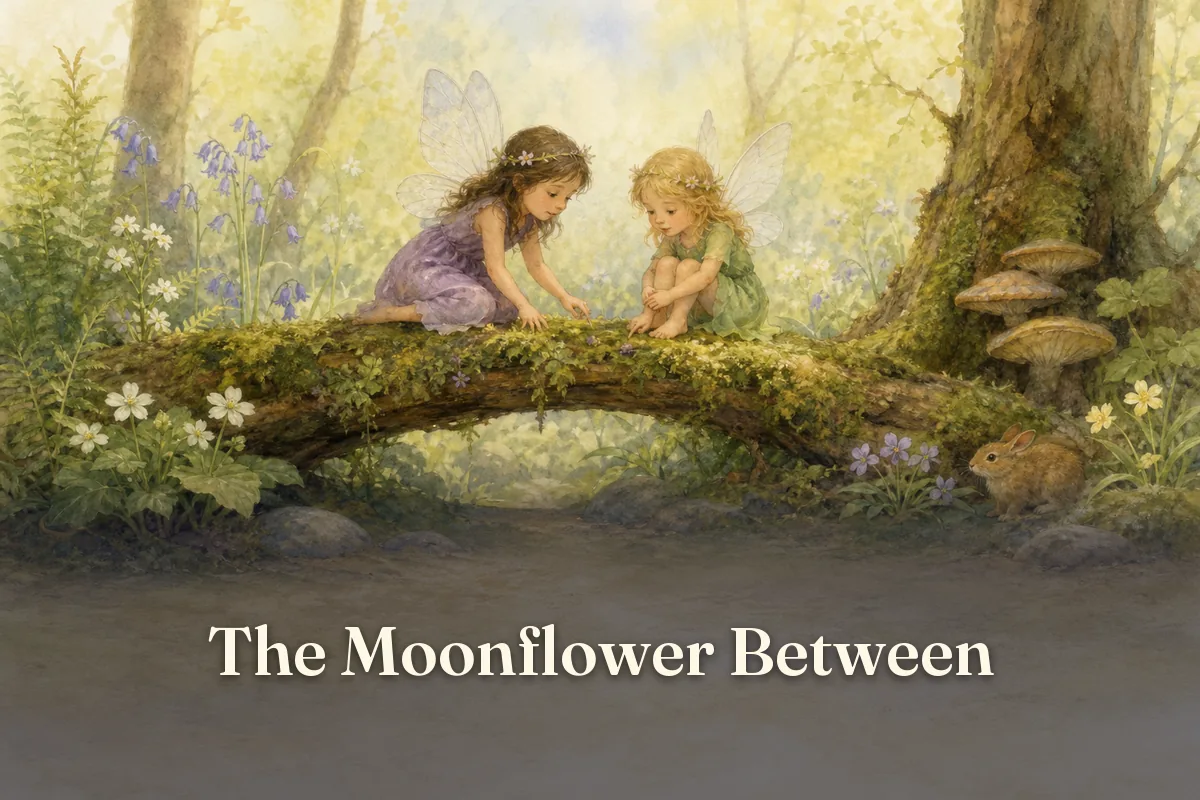
“It belongs by my window,” said Zara. “But I can see it best from my bench,” said Miles.
Between their two little homes lay a garden no wider than a picnic blanket. A stone path ran through the middle, with mint on one side and tiny blue bells on the other. Right in the center sat a clay pot holding a moonflower. Its green stem curled around a wooden stick, and a round bud rested at the top.
Zara had found the pot that morning beside her door. A note tied to its handle said, “For the neighbors to enjoy.” She had carried it into the garden, careful not to bump the bud.
“By my window, I can watch it open,” Zara said. Her window faced the garden, and she had already set a small cushion on the sill.
Miles pointed to his wooden bench. “From there, I can draw it in my picture book. I’ll make the petals as wide as my ears.”
“My ears aren’t that wide,” Zara said.
“They are when you’re wearing your winter hat,” Miles replied.
Zara giggled, but she still wanted the pot near her window. She picked it up and set it beside the little wooden fence on her side. The stem leaned toward her window.
Miles watched it. “It looks like it wants to see my bench.” He lifted the pot and carried it across the garden. He placed it beside his seat.
Now the stem bent the other way, stretching toward Miles’s bench.
“See?” said Miles. “It likes my spot.”
“Maybe it’s trying to find the sun,” Zara said. She moved the pot back by her window.
Miles moved it again. Zara moved it again. Each time, the pot scraped softly over the path, and each time the stem tilted toward its newest place.
At last, Zara put both hands on the pot and held it still. The little stem curved between the two homes, as if it couldn’t decide which way to go.
“Maybe we should ask the flower,” Miles said.
Zara looked at the round bud. “How?”
They waited beside the pot, watching the evening settle over their small garden.
The moon rose above the roofs, pale and round. Its light fell across the little garden path. Zara leaned close to the flower, and Miles set down his picture book.
“Look,” Zara whispered.
The moonflower’s stem was no longer leaning toward either window. Slowly, the bud turned upward, toward the moon.
“It isn’t looking at my window,” Zara said.
“Or at my bench,” Miles answered. He studied the flower from one side, then the other. “It’s looking up.”
Zara followed the stem with her eyes. The moon shone above the center of the garden, right between their homes. She glanced down at the path between them.
“What if we put the pot here?” she asked. “In the middle. Then we could both see it.”
Miles looked at his bench, then at Zara’s window. “I could draw it from the path. And you could sit here, too.”
Zara felt a little pinch of worry. The stem had been bent back and forth all afternoon. “We have to carry it carefully,” she said. “I don’t want to hurt it.”
“I’ll hold the pot,” Miles said. “You can guide the stem.”
Zara held the wooden stick steady while Miles lifted the clay pot. Together they took small steps along the path. Halfway across, a leaf brushed Zara’s sleeve.
“Sorry,” she whispered to it.
“You’re doing fine,” Miles told the leaf.
They set the pot down in the center. Zara loosened the soil around its roots with her fingertips. Miles turned the pot until the wooden stick stood straight. The stem eased upright, no longer pulled toward one neighbor or the other.
Zara found a flat stone and placed it beside the path. She added two smaller stones for seats. “There. One spot for each of us.”
Miles opened his book and began to draw the flower. “I can see every leaf from here.”
“And I can watch it open,” Zara said.
They agreed to take turns watering it. Zara would water on one day, and Miles on the next. They marked the first turn with a tiny blue pebble by Zara’s seat.
Then they sat together, looking up at the still-closed bud.
The garden grew quiet around them. From the mint patch came a cool, sweet smell. Somewhere beyond the roofs, a night bird called once, then settled down.
Miles kept his book open on his knees. He drew the moonflower with a round bud, two leaves, and a very straight stem.
“It looks like it’s standing tall,” Zara said.
“I think it likes the middle,” Miles replied. He shaded the path beneath the pot, then added two small elf shapes sitting beside it.
Zara watched the moonflower’s bud. The petals stayed folded, but the tip seemed to loosen a little at a time. She didn’t ask it to hurry. Miles didn’t either. They simply sat on their stones and let the garden be still.
After a while, Zara pointed to the drawing. “You made my ears the right size.”
“I used your garden ears,” Miles said. “They’re smaller than your winter-hat ears.”
Zara laughed, and the sound went across the path like a little bell. Miles laughed, too, but soon their voices faded. The moonlight rested on the pot, the blue bells, and the two seats they had made together.
The moonflower opened slowly. One white petal unfolded, then another, until the flower spread its face toward the moon. It stood between the two homes, where Zara could see it from her window and Miles could see it from his bench.
“There it is,” Zara murmured.
Miles closed his book without a sound. They sat side by side on the flat stones, watching the flower hold its shape in the night air.
At last, Zara rose and brushed a bit of soil from her knees. “Tomorrow is my turn to water it,” she said.
“And the next day is mine,” Miles replied.
They walked to their own doors, then looked back once at the open moonflower in the shared garden. Neither moved the pot. It rested exactly where both friends could enjoy it, beneath the quiet moon.