Elf Story
Whitney’s New Sunrise Song
Whitney misses her familiar chestnut tree when she moves into a hollow maple, where even her favorite sunrise song sounds different. With help from her neighbor Garrett, she begins listening to the new tree and the forest around it.
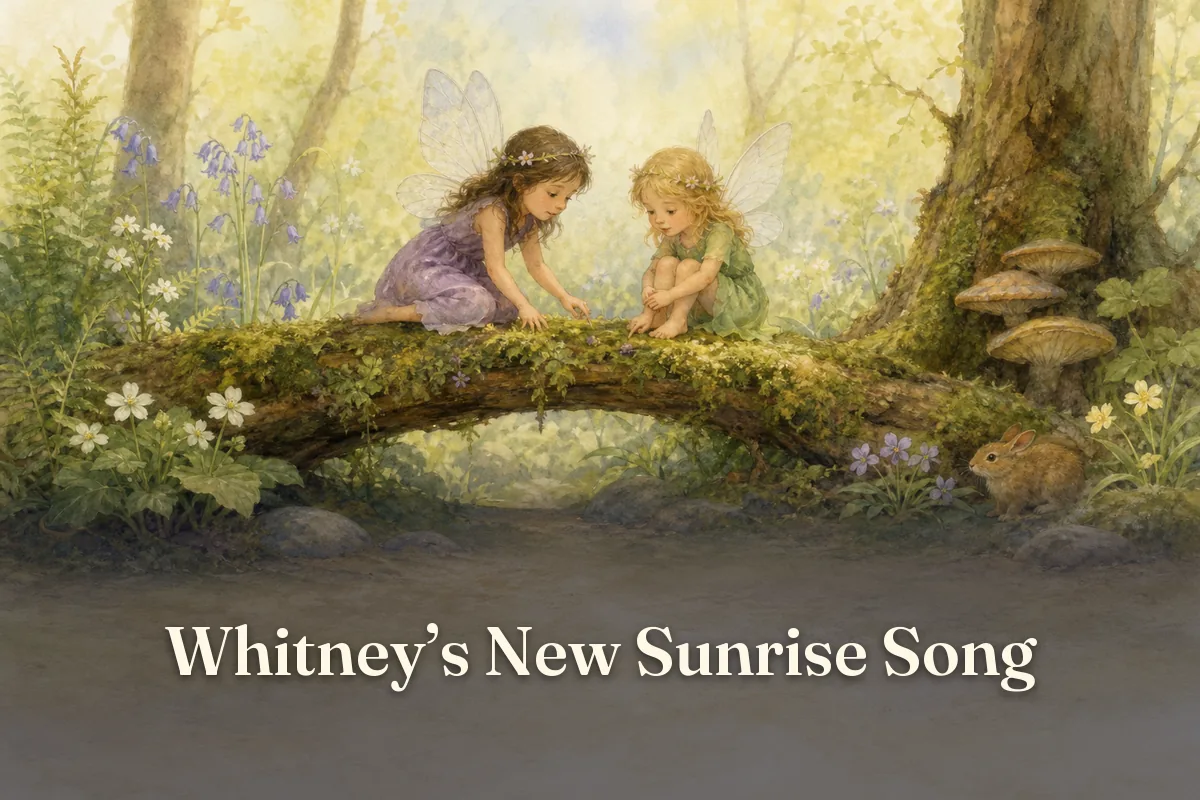
On her first morning in the new tree, Whitney hummed the sunrise song she missed.
She sat on a little stool inside her hollow maple home. The tune had traveled with her from the old chestnut tree, tucked safely in her memory. It began with three high notes, then dipped low, like a tiny bird settling on a branch.
But in the maple, the song sounded strange. The hollow walls sent the notes bouncing back in a deep, wobbly jumble.
Whitney stopped humming. “That isn’t how it goes,” she whispered.
Her old home had been snug and familiar. It had a round window that caught the first morning light, and a shelf where she kept a smooth, brown acorn. She knew every creak in its stairs. Now the acorn sat on a shelf in a different tree, and even its little room sounded different.
A knock came at the door. Garrett, an elf who lived in a nearby branch, peeked in. He wore a green scarf with one end tucked into his pocket.
“Good morning,” he said. “I heard a song. Was that yours?”
“It’s my old sunrise song,” said Whitney. “I wanted it to make this tree feel like home.”
Garrett looked around the hollow. “Maybe it needs to meet the tree first.”
Whitney wasn’t sure what that meant. Still, she followed him to the round window. Outside, the forest was quiet. A robin called from a fern. Somewhere above them, a little tap sounded against the roof.
“Did you hear that?” Garrett asked.
Whitney nodded. “A drop of water?”
They waited. Tap. Tap. A bead of dew fell from a leaf and landed on a knot in the maple’s bark. The sound was small and clear.
Garrett tapped his finger against the window frame. “Your old song has bird notes. Perhaps this tree has notes, too.”
Whitney looked back at her acorn on the shelf. She still missed the chestnut tree. But she listened again—to the robin, the tapping dew, and the new hollow that held her song in its own way.
“Tomorrow,” she said, “I’ll listen longer.”
The next morning, Whitney woke before the sun reached her window. She sat very still and listened.
The maple made a low creak as its branches shifted. Tap, tap went the dew on the bark. Outside, the robin gave one bright chirp, then another.
Whitney hummed her old tune. The three high notes came out thin, and the low note bounced back too loudly. She tried again, pressing her hands over her ears. It still didn’t sound like the chestnut tree.
“I can’t make it fit,” she said. “Maybe I should only sing it in my head.”
Garrett arrived carrying two cups of warm clover tea. He set them down and sat beside her. “What if the song doesn’t have to fit exactly?”
Whitney frowned. “Then it won’t be my song.”
Garrett pointed toward the roof. A drop landed on the bark. Tap. Then the maple creaked, low and slow.
Whitney’s shoulders loosened. “The tap could go before the first note,” she said. “And the creak could be the low part.”
She hummed the old tune again, but this time she began with two quiet taps on the wooden floor. She let the maple’s creak fill the space before her last note. Garrett listened, then added a small whistle, copying the robin.
The new song wobbled. Whitney stopped. “That whistle came too soon.”
“Then I’ll wait,” Garrett said. He smiled, but didn’t play another note.
Whitney listened once more. Tap, tap. Crrrreeak. Chirp. She raised her voice and sang her old tune around those sounds. The high notes were still hers. The low note belonged partly to the maple. Garrett’s robin whistle sat neatly between them.
When the song ended, the hollow was quiet for a moment.
Then Garrett clapped. “It sounds like both trees.”
Whitney looked at the acorn on her shelf. She could almost picture the chestnut’s round window, and she could hear the maple’s little morning sounds, too.
“It carries my old home,” she said, “but it belongs here now.”
Together, they sang it once more, slowly, so the new tree could learn every note.
On the third morning, Whitney woke smiling. Before she even sat up, she heard the maple begin its part: a low creak, followed by two soft taps from the dew.
She sang the sunrise song from her bed. Garrett’s whistle joined from the doorway, just when the robin called outside. The old tune curled through the hollow, carrying memories of the chestnut tree along with the maple’s own sounds.
After breakfast, Whitney put her brown acorn beside the round window. It fit on the shelf as neatly as it had in her old home. She didn’t feel that she had left one tree behind or had to choose another. The song held both places together.
In the days that followed, the morning sounds changed a little. Sometimes the robin sang first. Sometimes a branch creaked before the dew tapped the bark. Whitney and Garrett listened, then let the song make room for whatever the day brought.
One morning, the robin was quiet. Whitney sang the tune without its whistle, and the maple’s creak filled that little space. It sounded right. She grinned at Garrett, who answered with a small bow.
The next evening, they sat together by the window as the forest grew still. Garrett’s green scarf had slipped loose, and he tied it in a lopsided knot.
“Will the song change again tomorrow?” he asked.
“Probably,” Whitney said. “That’s what songs do when they have room to grow.”
She set the acorn close to her bed and tucked her blanket around her knees. The maple gave a familiar creak above her, like a quiet hello. Outside, leaves brushed one another, and the robin settled on its branch.
Whitney thought of the chestnut tree, with its round window and well-known stairs. She missed it, but the memory no longer felt like something she had to hold tightly. It rested inside her song, safe and warm.
She closed her eyes while the new hollow kept its peaceful sounds around her. In the morning, there would be a song to hear—and perhaps one small new note to welcome.