Moving Story
The Moon Picture
Lena’s new bedroom looks out on an unfamiliar street, and she misses the moon picture that hung beside her bed at home. As she searches through boxes with muddled labels, the story gently explores the small comforts that can help a new place begin to feel like yours.
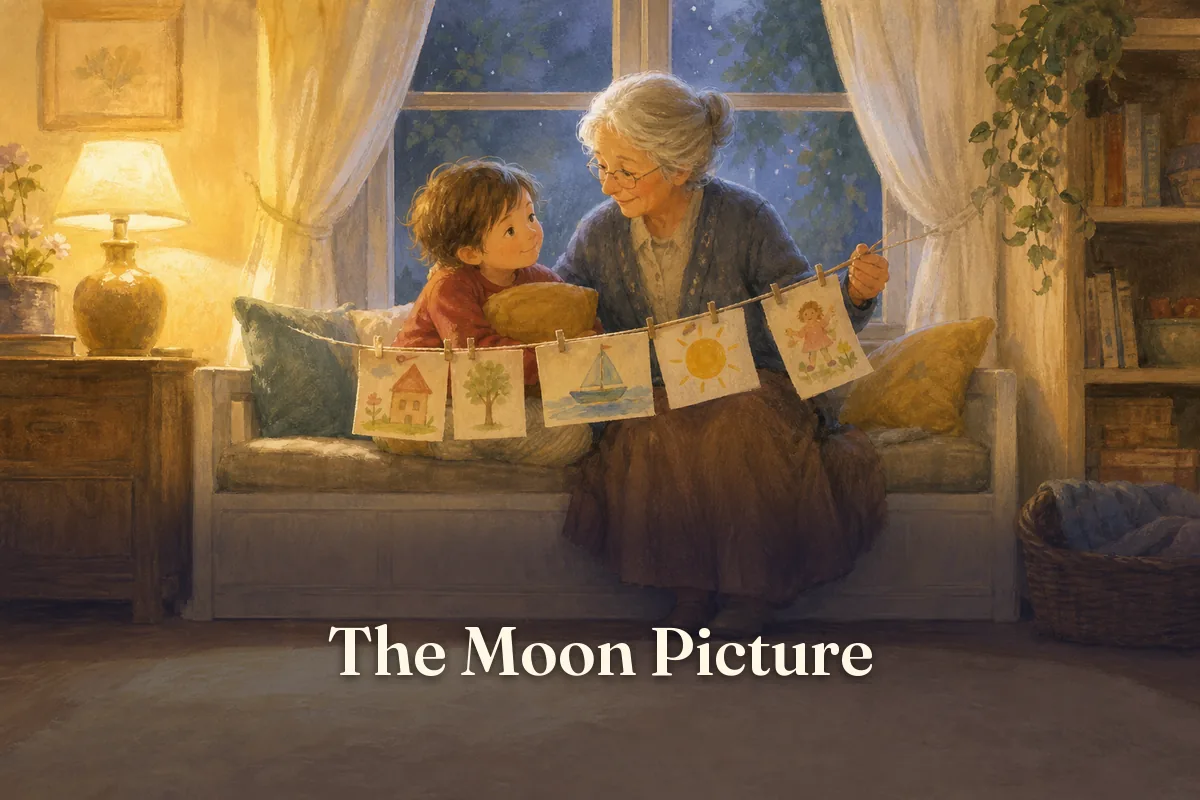
The new room had a window, but it did not look out on the same evening sky as Lena’s old one. Across the street, little windows blinked on, one by one. A tall tree swayed outside, and the moon was hidden behind a soft gray cloud.
Lena sat on the floor in her new bedroom. Around her stood several moving boxes, some tall, some squat, and one with a crumpled flap that looked like a duck’s beak. Her blanket lay folded on the bed, but the room still felt like a room waiting to meet her.
“I want my moon picture,” Lena said.
The picture showed a round yellow moon sailing over a blue hill. At her old apartment, it had hung beside her bed. Lena liked to look at it while she listened to the nighttime sounds outside. She wanted it beside this new window, where it could keep her company while the new room learned to feel like hers.
She checked the box marked BEDROOM. It held socks, a brush, and two books about whales. She checked the box marked BOOKS. It held a lamp shade, three scarves, and a wooden spoon.
“That spoon is not a book,” Lena told it.
She checked the box marked PICTURES. Inside were a small mirror, a calendar with a picture of a goat, and a frame with nothing in it at all. No moon.
Lena turned the box around and looked at the label again. The letters were clear, but the box had not kept its promise.
From the hallway, her dad called, “Do you need anything, Lena?”
“My moon picture,” she answered. “The boxes have mixed everything up.”
“Keep looking,” he said. “I’ll be right nearby.”
Lena looked at the boxes still waiting. Their labels seemed to point in every direction at once. She took a slow breath, brushed a bit of cardboard dust from her knee, and studied the room. The picture was somewhere in this apartment. She would find it, even if it was hiding in a very silly place.
Lena started with the box nearest the wall. It was marked KITCHEN, in big black letters. She lifted one flap and peered inside.
A colander rested on top. Beside it were a stack of napkins, a little bowl, and a bundle of wooden spoons. Lena leaned closer. The box smelled faintly like cinnamon, though she couldn’t see any cinnamon.
“Definitely kitchen things,” she whispered.
She lowered the flap and looked at the other boxes. One said HALL. One said MISC. The last one had a label that had come loose and stuck to its side upside down. None of them sounded promising.
Lena went back to the kitchen box. As she reached for the flap, something blue showed beneath the edge of a folded dish towel. Just a tiny corner. A blue corner with a thin white line curving across it.
Lena’s fingers stopped.
She knew that line. It was the trail of a little painted star beside the moon.
“Wait a minute,” she said.
She lifted the towel with both hands. Under it lay a saucepan wrapped in paper. Under the saucepan was a bundle of dish towels. And beneath those, snug against the bottom of the box, was a flat frame wrapped in brown paper.
Lena carefully moved the bowls and spoons onto the rug. She set the saucepan down gently, then eased the wrapped frame out of the box. The cardboard gave a quiet creak. Lena held her breath until the frame was free.
She peeled back the paper. There was her moon, round and golden, above the blue hill. The little star still curved beside it.
“I found you,” Lena said.
She carried the picture to the wall beside the new window. A small hook was already there, left from the last family’s curtain tie. Lena stood on her toes and lifted the frame by its little wire loop. It slipped over the hook, wobbled once, then settled straight.
The moon picture rested beside the window. Lena stepped back and looked. The room still held boxes, and the tree outside still swayed in a sky she did not know yet. But her favorite picture was right where she had chosen to put it.
For a little while, Lena stayed standing by the window. The moon picture caught the lamplight, and its painted hill looked almost silver at the edge. Outside, a car rolled softly along the street. Somewhere in the building, a door clicked shut.
Lena tilted her head to see the picture from her bed. From there, the moon seemed to float beside the window, looking out at the unfamiliar tree. A small breeze stirred the leaves. The picture did not move at all.
Her dad appeared in the doorway. He looked at the box with the spoons and bowls on the rug, then at the picture on the wall.
“Kitchen things?” he asked.
“Mostly,” Lena said. “The moon was hiding under them.”
He smiled. “It found a good spot.”
Lena climbed onto the bed. Her blanket was soft beneath her hands, with its familiar stitched edge and one little bump where a patch had been sewn on. She smoothed it once, then tucked her feet beneath it.
The new window showed a different slice of the evening. The tree made dark, gentle shapes against the sky. The moon was still behind its cloud, but Lena could see her painted moon beside the glass, bright and round above its blue hill.
She imagined the picture watching the tree’s leaves sway, just as it had watched the quiet sky outside her old room. The apartment made small settling sounds around her: a tick from the heater, a hush from the hallway, the faint rustle of the blanket as Lena pulled it up to her chin.
Her dad switched off the lamp. A little light from the street rested on the wall, just below the picture. Lena’s eyes grew heavy. She looked once more at the moon beside the window, then rested her hand on the soft edge of her blanket while the room grew quiet around her.