Forest Story
Sam’s Two-Note Call
Sam reaches a familiar forest clearing while Aunt Lila is still on the trail, and his first attempts to call don’t carry through the trees. He remembers a signal they practiced together and tries it from an open spot.
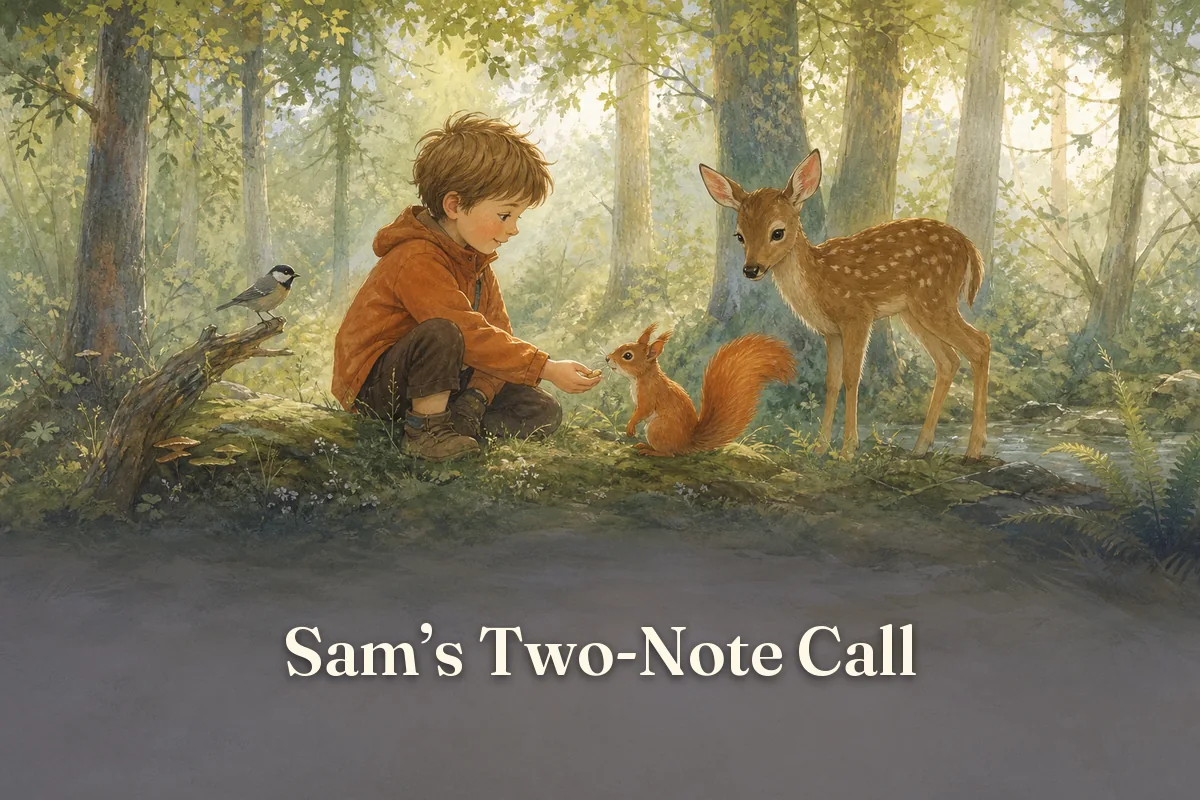
Sam’s voice rang across the clearing. “I made it!” The forest answered with a soft hush of leaves.
Sam stood where the familiar trail opened into a patch of grass. Ferns edged the clearing, and a flat stone sat near the middle like a little table. He knew this place from other walks with his aunt, but today he had reached it first.
Aunt Lila had stopped a short way back to tie her shoe. “Wait where the trail opens up,” she had told him. “I’ll join you as soon as I’ve tied this. Call when you get there.”
Now Sam wanted her to know he had made it. He cupped his hands around his mouth.
“I made it to the clearing!” he called again.
The sound seemed to travel a little way, then melt among the trunks. The trees stood close beside the trail, with branches and leaves overlapping above it. Ferns, shrubs, and moss filled the spaces below. All those plants softened some sounds, and the thick woods could block others.
Sam waited. A bird gave a short, bright chirp. Somewhere farther off, a squirrel scratched at bark.
No Aunt Lila.
Sam tried a whistle. He pursed his lips and blew. It came out thin and tiny, more like a sleepy tea kettle than a forest signal.
“Maybe she didn’t hear that,” he murmured.
He looked down the trail. It curved behind a stand of tall pines, and he could not see Aunt Lila from here. For one moment, he thought about walking back to find her. Then he remembered her words: Stay where the trail opens up.
Sam stepped to the middle of the clearing, where the trees stood farther apart. He tried to picture the little signal game they had practiced on walks. It had two notes: one high, one low. Aunt Lila would answer with the same two notes.
Sam smiled. He knew what to try next.
He stood still among the grass and listened to the leaves moving overhead. Then he set his lips for the first note.
Sam blew a high note, then a lower one.
“Pee-oo!”
This whistle sounded clearer in the open clearing. Sam listened with both hands resting at his sides. For a few seconds, no one answered. A twig rubbed against another somewhere above him, and the leaves shifted in the breeze.
Then the forest sent back two notes.
“Pee-oo!”
Sam’s eyes widened. “Aunt Lila!” he called, but he stayed where he was. He knew the reply meant she had heard him. He sent the two notes again, high and low.
“Pee-oo!”
A moment later, the same two notes came from the trail. They sounded a little closer.
Sam wanted to hurry toward them, but he remembered the plan. If they both moved, they might pass each other among the trees. So he stayed in the open spot and waited for the next reply.
“Pee-oo!” he called.
“Pee-oo!” Aunt Lila answered.
The calls came and went, like two little birds taking turns. Sam could tell the sound was nearer now. He kept his feet planted in the grass. His fingers curled around the edge of his shirt, but he felt calm. He had found a good way to let Aunt Lila know where he was.
At the trail entrance, a branch bobbed. Then Aunt Lila stepped into view, smiling.
“There you are,” she said. “Your first whistle was too quiet for me to hear through all those trees. But your two-note call carried from the clearing.”
“I remembered our game,” Sam said. “And I stayed right here.”
“That was just right,” said Aunt Lila. “I heard you, answered, and followed the sound. You waited, so I knew where to find you.”
Sam gave one small nod. The woods seemed full of places for a sound to hide, but the open clearing had helped his whistle travel. Aunt Lila had kept answering, and he had kept listening.
Together they walked the few steps to the flat stone. Their picnic blanket lay folded beside the basket, just where Aunt Lila had left it. Sam helped spread it over the grass.
The blanket settled with a quiet flap. Aunt Lila set the basket beside it, and Sam chose a spot where he could see the trail entrance and the leafy edge of the clearing.
“Now that I can hear you close by,” he said, “I don’t need a big whistle.”
“That’s right,” Aunt Lila said. “A whistle can carry farther than a quiet speaking voice, especially when you have a clear place to send it from. And when we’re close, we can talk softly.”
Sam touched his lips and made a tiny high note, then a tiny low one.
“Pee-oo,” he whispered.
Aunt Lila answered just as quietly. “Pee-oo.”
This time the notes did not have to travel far. They rested between them like a secret made just for the clearing.
They unpacked apple slices, cheese, and two small sandwiches. Sam told Aunt Lila how the clearing had looked when he first stepped into it: the flat stone, the ferny edges, and one curled leaf that looked like a green canoe. Aunt Lila asked if he had heard the bird near the pines. Sam had heard it, though he did not know its name.
They ate slowly. A breeze combed through the treetops, and the branches moved together with a sound like a brush sweeping a floor. The trail stayed quiet. Nothing hurried them.
When the basket was nearly empty, Sam leaned back on his hands and watched a patch of sky between the branches. “I’m glad I remembered the two notes,” he said.
“So am I,” said Aunt Lila. “You thought carefully, chose an open spot, and stayed where we could find each other.”
Sam rested his cheek against her shoulder for a moment. The familiar trail waited nearby, and the clearing felt peaceful around them. They folded the blanket, picked up the basket, and began their easy walk home together.
At the edge of the trees, Sam and Aunt Lila paused side by side. They gave one last, very quiet two-note whistle, and the woods held it gently between the leaves.
Good to know
- Trees, branches, leaves, and understory plants can soften or block some sounds.
- A whistle can carry farther than a quiet speaking voice, especially from an open area.