Castle Story
The Little Bell Beneath the Arch
Tilda has been chosen to start the castle’s lantern parade, but the tower bell is out of reach and her own silver bell seems too small. With help from Pipkin, a sleepy gargoyle, she explores the courtyard to find a way for everyone to hear her signal.
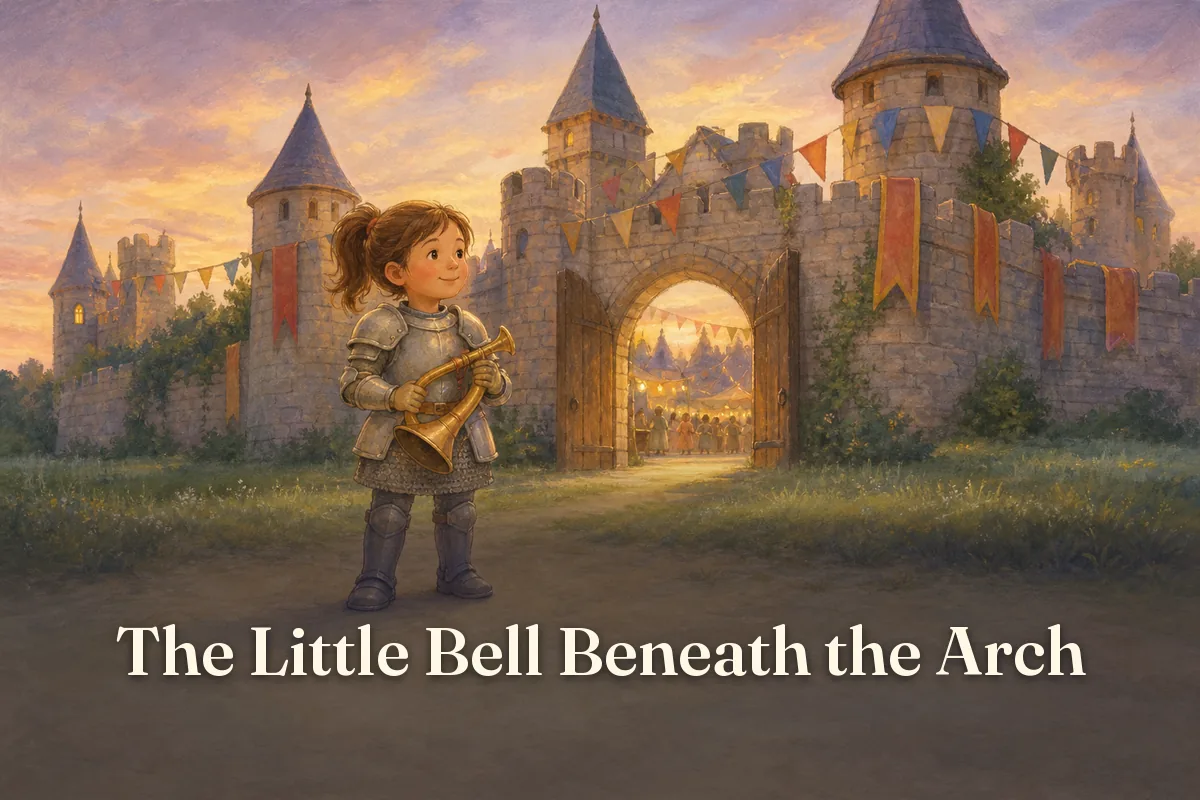
The silver bell felt cool in Tilda’s hands.
The castle courtyard was busy with evening preparations. Knights buckled on bright belts, cooks carried baskets of warm rolls, and servants set paper lanterns along the stone path. Soon they would all walk together in the lantern parade, winding past the garden and through the great gate. Tilda, the smallest castle page, had been asked to start it.
She looked up at the big bronze bell in the tower. Its rope hung high above the courtyard, far beyond her reach. A tall knight tried pulling it, but the rope had been tied up for the evening so no one would tug it by mistake. Tilda’s own bell was no bigger than an apple. Its sound seemed much too small for all those people.
“What if nobody hears me?” she whispered.
Above her, on a stone ledge, a gargoyle blinked one sleepy eye. His name was Pipkin. He had a round nose, folded wings, and a little mossy cap that had grown between his horns. Most days, he sat watching the courtyard. Most evenings, he tried not to fall asleep before the lanterns were lit.
“Did someone say ‘hear’?” Pipkin asked. His voice sounded like a pebble rolling in a bowl.
“I’m meant to begin the parade,” Tilda told him. “But the tower bell is too high, and my bell is too little.”
Pipkin leaned forward. “Little things can travel farther than they look.”
Tilda turned the silver bell in her hands. “How?”
“I’m not quite sure,” he said, closing his eyes for a moment. “But I know the courtyard has a way of carrying sounds. Listen to it.”
Tilda listened. A cook called for a tray. A horse gave a friendly snort. Boots shuffled on the stones. Beyond the lantern table, the old stone arch stood between the courtyard and the garden path. Its curved opening framed the waiting parade like a doorway in a picture.
Pipkin nodded toward it. “Perhaps that arch knows something.”
Tilda tucked the bell safely in her apron pocket. She and Pipkin set off across the courtyard to find out.
The arch was wide enough for three horses to pass through side by side. Its stones were worn smooth where many hands had brushed them over the years. Tilda stood in the middle of the courtyard, facing the arch, and rang her little bell.
Ting.
The note went straight out into the open air and faded before it reached the knights. Tilda’s shoulders drooped. “That won’t reach them.”
Pipkin shuffled closer, making a quiet scrape against the ledge above the arch. “The arch is curved like a long stone horn,” he said. “Stand beneath its courtyard side. Lift your bell toward the stones, and let them carry the sound.”
Tilda stepped under the curved opening and raised the bell. She thought about the people waiting: the knights with their polished helmets, the servants holding lantern poles, and the cooks who had put aside their spoons to join the parade. She wanted them all to begin together. Then she rang.
Ting!
The curved stones caught the bright note and carried it along the arch. A clear echo came from the far end and spilled across the courtyard. Ting! The sound reached the lantern table. It skipped toward the kitchen door and rang beside the tower steps.
A stable boy looked up. “Was that the parade bell?”
“It came from the arch!” called a cook.
Tilda stared at Pipkin. “The stones carried it all the way across!”
“They listened first,” Pipkin said. “Then they answered.” He tried to nod proudly, but his eyelids drooped halfway shut.
Tilda stood beneath the arch, holding her bell up toward its curve. This time she did not worry about how small the bell looked. She lifted it high and rang with all the courage she could gather.
Ting-a-ling!
The note traveled along the arch and spread through the courtyard. One knight raised his lantern. Then another. The servants formed two neat lines, and the cooks joined behind them, still wearing their flour-dusted aprons. From the far end of the yard came a cheerful chorus: “We heard it!”
Tilda’s smile grew. Her sound had reached everyone—not because it was the biggest sound, but because she had found the right place to ring it.
She rang once more beneath the arch. The knights stepped forward, the lanterns lifted, and the parade began. Tilda walked at its head with the silver bell in her hand. Above, Pipkin watched them pass, pleased that a tiny note could lead such a grand procession.
The parade moved at an easy pace through the courtyard. Lanterns swayed above the knights and servants, laying golden shapes across the stones. Tilda walked beneath them, keeping her little bell close. Each time she passed under the arch, she rang once, and its curved stones sent a clear echo across the courtyard.
Pipkin stayed on his ledge, watching the lanterns pass. He counted the people as they went by, but lost count when a cook waved a wooden spoon at him. He lifted one stone paw in reply.
“Good evening, Pipkin!” Tilda called.
“Good evening, Bell Captain!” he answered. His sleepy voice rumbled down from the ledge.
Tilda laughed. She had never been a captain before, but she liked the sound of it. At the garden path, the parade turned around and came back through the arch. The knights marched more slowly now, and the servants carried their lanterns with both hands. The cooks shared the last warm rolls, breaking them into small pieces for anyone who wanted one.
When everyone had returned to the courtyard, the lanterns were set along the walls. The parade was over, but no one hurried away. They stood together for a little while, talking quietly about the arch and the clever bell that had found its way around the whole castle.
Tilda climbed the steps to Pipkin’s ledge. She sat beside him, careful not to bump his mossy cap.
“I thought a small sound couldn’t matter,” she said.
Pipkin gave a slow, thoughtful blink. “A sound does not have to be loud to be heard. Sometimes it needs a good place to begin.”
Tilda rested the bell in her lap. “And a friend who knows where to look.”
Pipkin’s mouth curled into a pleased stone smile. Below them, the courtyard grew quiet. One by one, servants carried the lanterns indoors. The knights headed toward their rooms, their boots making softer sounds with every step.
Tilda leaned against the warm stone beside Pipkin. He drew his folded wings in, while Tilda’s eyelids slowly began to close. The little silver bell rested quietly between them.