Waterfall Story
The Bird Beyond the Waterfall
A waterfall is loud enough to cover the song Kit hopes to hear. With Aunt Jo, Kit follows a marked trail to a quieter place and listens patiently among the trees.
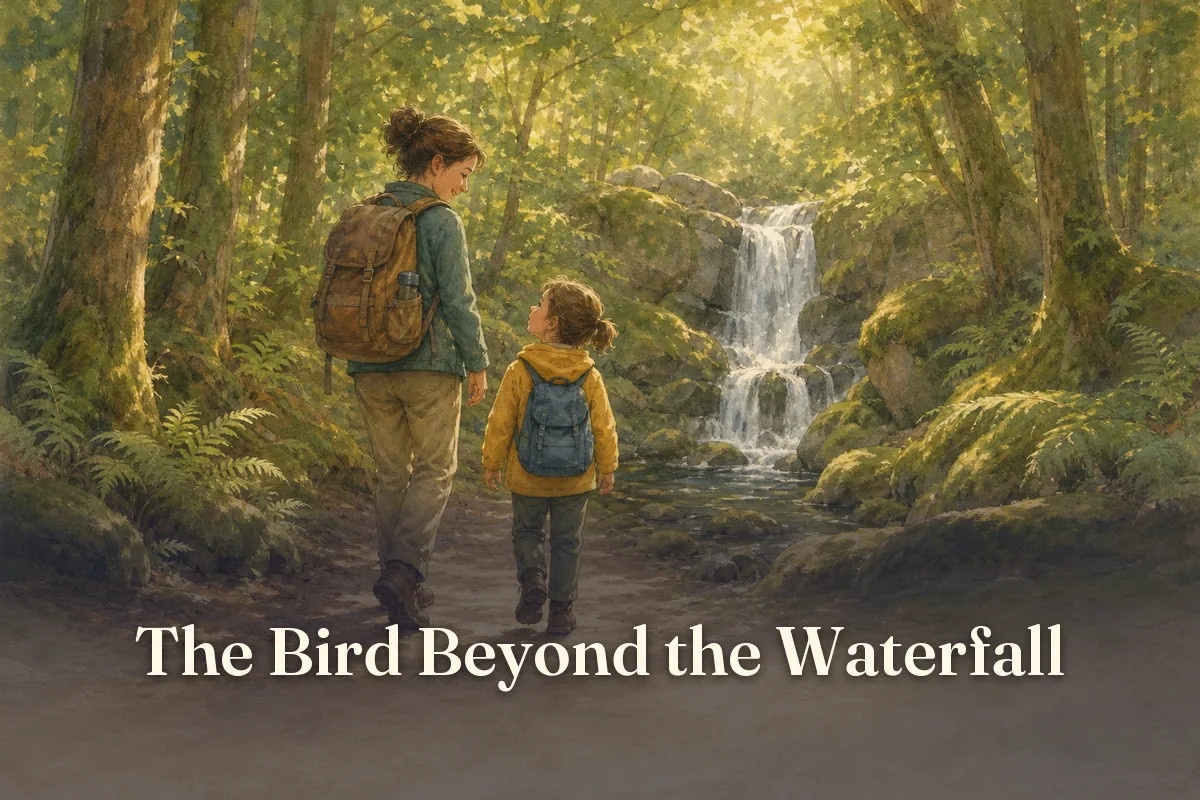
Can you hear the little bird? At the waterfall overlook, its song is there—but the rushing water is louder.
You stand beside Aunt Jo on the wide, marked path. A sturdy rail runs along the overlook, and you stay behind it while you look down at the waterfall. Water pours over the rocky ledge and tumbles into the pool below. It makes a great shhhh-ROAR that you can feel in your chest.
“Somewhere near us, a little bird is singing,” Aunt Jo says. “Let’s see if we can hear it.”
You tip your head. You listen hard. The waterfall roars. A leaf rustles beside the trail. Somewhere above, a branch creaks. But no bird song reaches your ears.
“Maybe it’s tiny,” you whisper.
“Maybe,” Aunt Jo says. “And this is a very loud place to listen.”
Your family has come for a short walk, and you were hoping to hear the bird before you head back. You imagined a clear, sweet tune, like a whistle made just for you. You don’t want to see the bird up close or make it come to you. You only want to hear its song.
You stand quietly at the overlook. The water keeps rushing, rushing, rushing. You try closing your eyes, but the sound fills them up, too. It is like a giant whooshy blanket spread over every smaller sound.
Aunt Jo points to the trail sign. “We can stay on the marked path,” she says. “It curves around that bend.”
You look along the trail. It is broad and easy to follow, with little signs showing the way. After the bend, it passes through a patch of trees, farther from the waterfall.
You picture the bird tucked among those branches. Would its song be easier to hear there?
“Could we try the quieter part?” you ask.
Aunt Jo smiles. “That’s a good idea, Kit. We’ll walk slowly and keep our voices low.”
You take one last look at the foaming water. Then you turn with Aunt Jo toward the curve in the trail, ready to listen somewhere else.
You and Aunt Jo follow the marked trail around the bend. Your family walks just ahead, speaking in quiet voices. The waterfall is still there, but the trees and the distance soften its roar. It no longer fills up every bit of the air.
At a small, level patch beside the trail, Aunt Jo stops. There is room to sit on a broad wooden bench. Ferns grow nearby, and branches make a leafy roof overhead.
“Let’s rest here,” she says. “We’ll stay on the path and give the bird plenty of space.”
You sit beside her. Your shoes rest on the ground. Your hands stay in your lap. You don’t call or clap or search through the leaves. You simply listen.
At first, you hear the waterfall, far off now: shhhhh. Then you hear a breeze brushing the branches. A tiny tapping sound comes from somewhere above. You hold still, wondering if that might be the bird.
Aunt Jo gives you a patient smile. Neither of you says a word.
Then—“Tsee! Tsee-tsee!”
The notes are small and clear. They come from a branch beyond the trail, where a little brown bird sits with its tail lifted. You can’t see every feather, but you can see its head turn. It sings two more quick notes.
Your eyes widen. You keep your body quiet, just as you promised.
“There it is,” Aunt Jo whispers.
You nod. The bird sings again, then hops farther along the branch. You don’t follow it. You don’t need to. You have heard the song, and the bird can keep its quiet place.
For a little while, you listen to both sounds. The waterfall makes its steady shhhh in the distance. The bird adds a bright little tune above it. They don’t have to compete now. There is room for each sound to reach you.
At last, the bird turns away into the leaves. You and Aunt Jo stay seated for another peaceful moment, giving it space.
“That was worth listening for,” she says.
“It really was,” you whisper. You stand beside her, careful and unhurried, and turn back toward the trail.
The walk back is just as short as the walk out, but now every part feels familiar. You pass the leafy patch where you sat. The bird stays hidden among the branches, and you leave it in peace.
As the trail curves, the waterfall grows louder again. First it is a distant shhhh. Then it swells into its big, rushing roar. You walk beside Aunt Jo, staying on the marked path, while the water tumbles over the rocks behind you.
At the overlook, you stop once more behind the rail. The waterfall is still grand and noisy. You can see the white water racing down and spreading into the pool. This time, you don’t try to hear the bird through the roar. You remember where the quieter trail bends, and you remember the notes that reached you there.
“Which sound do you like best?” Aunt Jo asks.
You think about it. “Both,” you say. “The waterfall is a big shhhh. The bird is a little tsee-tsee.”
Aunt Jo chuckles. “That’s a good way to remember them.”
Your family gathers on the path, and you all begin the easy walk back. The waterfall keeps rushing behind you. With every step along the trail, it seems a little farther away and a little quieter. You don’t need to hurry. You can still hear it for a while, rumbling among the trees.
On the way, you notice a pinecone by the path and a patch of moss on a stone. You don’t stop for another adventure. You simply walk beside Aunt Jo, carrying the sounds in your thoughts: the broad, rushing water and the bird’s few clear notes beyond it.
When you reach home, the day has settled into its quiet evening ways. You tell your family how the waterfall covered the song at first, and how the curving trail led you to a place where you could listen. Aunt Jo nods as you make the bird’s little tune one more time: “Tsee-tsee.”
Later, tucked into bed, you think of the marked trail winding past the trees. You hear the waterfall in your memory, then the tiny bird answering from its leafy perch. Both sounds belong to the same walk, and both stay with you as the house grows still and you settle into sleep.
Good to know
- Waterfalls can be loud enough to make it difficult to hear nearby sounds.
- Staying on marked trails and giving wild birds space helps avoid disturbing them.