Beach Story
Jordan’s Little Beach Museum
Jordan loves making labels, so a quiet stretch of beach becomes the perfect place to create a museum with Harper. When the breeze starts rearranging their display, the friends find a new way to share their discoveries while caring for the shore.
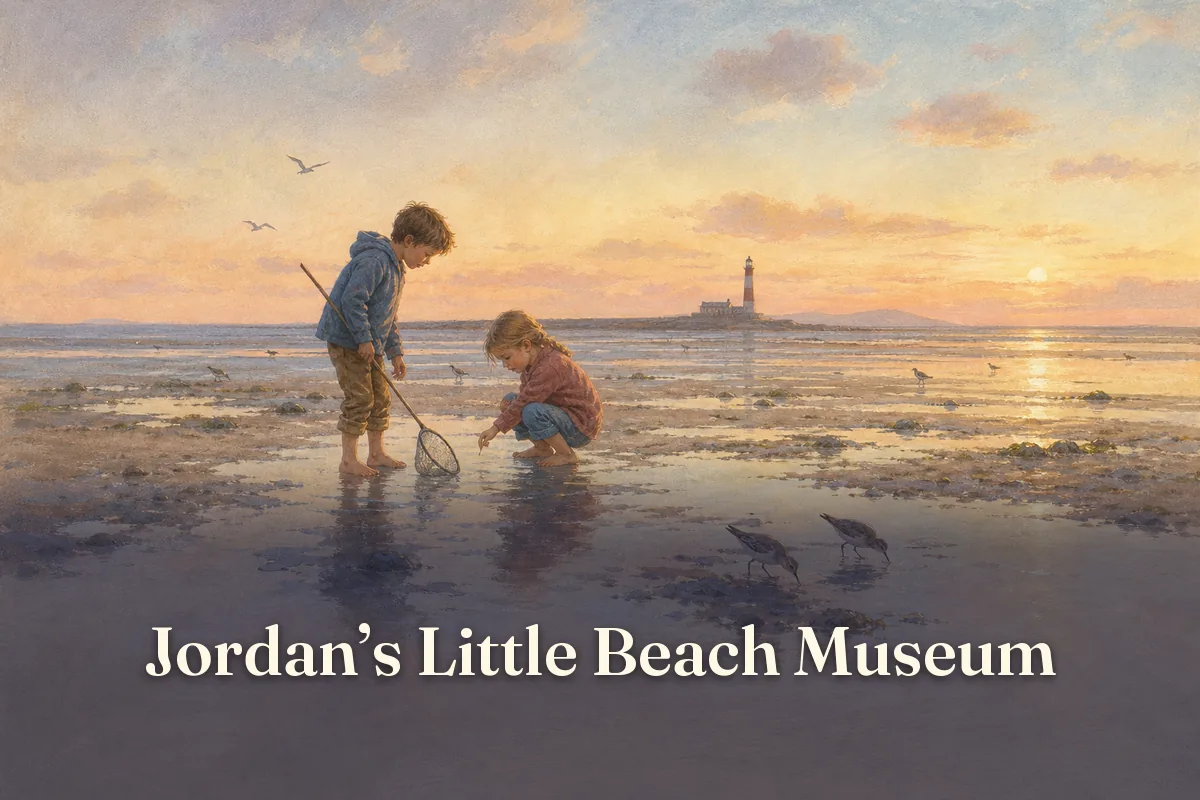
Jordan wrote “THE BEACH MUSEUM” in big letters, and the breeze immediately folded the sign in half.
“Oh!” Jordan said, catching it before it skittered away. “The museum is already having a problem.”
Harper laughed and held down the corners of their towel. They had chosen a quiet stretch of beach above the wet sand, where the tide had left little treasures behind. Shells lay open-side down or turned like tiny bowls. Smooth stones rested among ribbons of seaweed. Beyond them, the water made a hush, then a hush again.
Jordan loved making labels. At home, labels helped tell the crayons from the markers and the socks from the mittens. Today, Jordan had brought a small pad of paper and a pencil to make labels for a beach museum.
“Shells with stripes,” Jordan announced, placing a pale shell on the towel. “Smooth stones. Seaweed that looks like a green noodle.”
“Can I make a label, too?” Harper asked.
“Of course. You can be the assistant museum maker.”
Harper picked up a little gray stone and turned it in their palm. “This one looks like a sleeping seal.”
Jordan wrote: SLEEPING SEAL STONE. Harper set it beside the shell.
They walked only over the open sand, looking for things that were loose and empty. A small sign near the beach path reminded visitors that local rules might limit what people could take. Jordan pointed to it.
“We can look closely and put everything back when we’re done,” Jordan said. “Then the beach keeps its treasures.”
Harper nodded. “And the museum can be here just for us.”
They found a few more empty shells and smooth stones, each one different from the last. Jordan gave every find a label. A round shell became MOON CUP. A flat stone became PANCAKE ROCK. Harper suggested that a curled piece of seaweed looked like a sleepy green ribbon, though they left it on the sand.
Jordan arranged the labels in a neat row and stood the big sign upright at the back of the towel.
“Welcome to our museum,” Jordan said.
For one quiet moment, the little display looked ready. Then the breeze swept over the open beach. The sign bent. The labels lifted. And one small shell began sliding across the towel.
“Museum emergency!” Harper called, chasing the shell with one hand while keeping the towel from flapping with the other.
The wind was not loud, but it had plenty of room to run across the beach. It scooped up Jordan’s paper labels and sent them fluttering. One landed upside down. Another slid under a stone. The shell collection shuffled across the towel as if the museum had decided to change rooms.
Jordan caught the big sign, but it folded again. “I wanted everything to stay in order long enough for us both to see it.”
Harper picked up the sleeping seal stone. “Maybe the beach is rearranging the exhibits.”
Jordan looked at the labels lifting at their corners. Then Jordan looked at the smooth, heavy stones. A new idea took shape.
“The labels don’t have to stand up,” Jordan said. “They can lie flat, with a stone holding each one down.”
“Like a paper blanket!” Harper said.
They moved the display from the towel onto firm, open sand, well above the wet edge. Jordan pressed shallow circles into the sand with a fingertip. Harper placed a shell or stone inside each circle. The little dips helped keep the finds from sliding far, and the sand made each one seem to have its own tiny room.
They used only loose, empty shells and smooth stones they had found on the open sand. The seaweed stayed where it had washed ashore. Jordan tucked each paper label beneath a heavier stone, leaving the words visible. Harper set the folded sign flat at the top and held it down with two stones.
“Welcome to the Beach Museum,” Jordan read. “Exhibit one: Moon Cup. Exhibit two: Pancake Rock.”
“And exhibit three,” Harper said, pointing to a curved shell, “the Mermaid’s Listening Ear.”
Jordan wrote the new label. This time the wind lifted only one corner before the stone settled it again.
The friends took turns being the museum guide. Harper described how the gray stone fit neatly in a palm. Jordan explained that no two shells had exactly the same lines. They leaned close, noticing tiny grooves and sandy specks they had missed before.
At last, Jordan and Harper lifted the labels and checked the sand for every find. They returned the shells and stones to the open beach, setting them down gently. Jordan folded the paper labels and put them away to take home.
The museum was finished, and nothing from the beach needed to travel with them.
Jordan and Harper walked back along the beach path with the folded labels safe in Jordan’s pocket. Behind them, the little museum had become part of the shore again: shells among shells, stones among stones, each one resting where the two friends had placed it.
“Which exhibit was your favorite?” Harper asked.
“The Mermaid’s Listening Ear,” Jordan said. “It looked as if it could hear the waves telling secrets.”
Harper thought for a moment. “I liked the sleeping seal stone. It felt like it belonged in a story.”
“It can be in the story we tell at home,” Jordan said. “We don’t have to carry it to remember it.”
The beach path curved between tufts of grass. The breeze followed them, but it could not take the labels from Jordan’s pocket. They were folded together now, with the museum’s name on top and a few sandy marks along the edges.
Harper remembered how the shell had slid away. Jordan remembered the labels fluttering like little birds. They both remembered how the stones had held everything steady, and how their shallow sand circles made each find look special without needing a wall or a roof.
“Tomorrow,” Harper said, “I might draw the museum.”
“I’ll make labels for the drawing,” Jordan replied. “A very tidy drawing museum.”
They smiled and kept walking. Their voices grew quieter as the path led away from the water. Behind them, the waves continued their easy hush, washing the beach and leaving room for other treasures to be found another day.
At home, Jordan would smooth the paper labels on a table and show them to the family. Harper would tell the story of the wind that tried to rearrange the exhibits, and how two stones gave each label a place to stay. The friends would remember the pale shell, the flat rock, and the little circles pressed into the sand.
For now, the beach was peaceful, and the museum belonged to the shore again. Jordan and Harper carried home only their words and memories, while the sea kept its quiet stories moving along the sand.
Good to know
- The story advises checking local rules, which may limit what visitors can take from a beach.
- Jordan and Harper leave the seaweed where it washed ashore and return the shells and stones to the beach.
More stories: Pick a Pirates and Treasure Story for Your Child