Astronaut Story
Isaac and the Dusty Label
During a lunar-training exercise, astronaut Isaac discovers that dust has rubbed the writing off a sample rock’s label. With Mara’s help, he checks their notes and location photos to identify the rock without guessing.

Isaac held up the little rock. Its label had turned into a gray smudge.
“Oh, crumbs,” he said. “I can’t read a thing.”
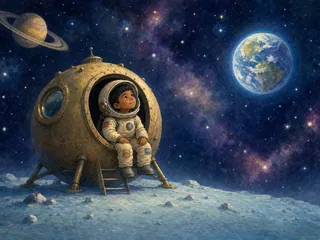
Inside the Earth-based lunar-training station, his crewmate, Mara, leaned closer. Beyond the round window lay a rocky, dusty practice landscape. Low hills stretched across the ground, and their small station stood beside a row of equipment cases.
“That rock came from today’s sample walk,” Mara said. “But which spot?”
Isaac looked at the rock in his gloved hand. It was no bigger than a walnut, with a pale stripe down one side. He had collected it during their training mission, then written its location on a little tag. Dust had clung to his glove and rubbed the writing away.
He set the rock carefully in a clean tray. “I want to label it right before we put it away.”
“That’s important,” Mara said. “We record where practice samples come from so we can learn to keep careful notes on a real Moon mission.”
Isaac nodded. He had learned about the Apollo astronauts, who collected real Moon rocks and soil during their missions. Scientists still studied those samples because the collection places and details had been recorded.
“Let’s check the mission notes,” Mara said.
Isaac opened the notebook on the worktable. There were three stops listed: the flat stone, the forked ridge, and the shallow dip. Each had a short code. His tag had once held one of those codes, but now it showed only a blurry gray streak.
“I remember the walk,” Isaac said. “We stopped by the ridge, and we stopped near the dip.”
Mara pointed to the three small sample bags in the tray. “And you picked this rock up after we had moved around a bit.”
Isaac felt a small pinch of worry. He could not simply choose the place that sounded right. He turned the rock slowly, careful not to let it roll. Its pale stripe seemed familiar, but familiar was not the same as certain.
“Maybe the notes will give us another clue,” he said.
He opened the mission folder beside the notebook. A small camera sat in its charging cradle, and a row of location photos waited on the screen. Isaac leaned toward them. The answer was somewhere in those pictures, if he could match the rock to the right moment.
Isaac tapped the first photo. It showed a broad, flat stone with a little sample pouch beside it.
“No,” he said. “That was the first stop. I remember setting the scoop down there.”
The next picture showed the forked ridge. Two low rock arms pointed in different directions, like a trail sign. Isaac studied the image, then looked again at the little rock.
“Could it be from here?” Mara asked.
“Maybe,” Isaac replied. He paused. “But I don’t want to guess.”
He flipped to the mission notes. Beside each stop, he had written the time, the sample code, and a short description. At the ridge, he had collected a dark, flat piece. This rock was pale and rounded. That clue ruled out the ridge.
“One more photo,” Mara said.
Isaac opened the last picture. It showed the shallow dip, where fine dust gathered between two stones. In the corner of the image, a small pale rock with a stripe lay beside Isaac’s boot.
“There!” Isaac said. “That stripe. That’s our rock.”
He checked the notes. At the shallow dip, the code was D-three. The time matched the mark on the photo, too. Isaac looked from the image to the notes, then to the rock in its tray.
“D-three,” he said. “Now I know.”
Mara smiled. “You found it by checking, not guessing.”
Isaac took a fresh label from the supply drawer. He wrote the code in large, clear letters. Beneath it, he added “shallow dip,” then the training date and the sample number. He read each part aloud while Mara followed along in the notebook.
“D-three. Shallow dip. Sample one.”
“Matches,” Mara said.
Isaac placed the new label on a clean sample container. He lifted the rock with care and set it inside. The pale stripe faced up, just as it had in the picture. Then he closed the container and slid it into the marked storage tray.
The label stayed neat and easy to read. Isaac checked it once more against the mission notes. Everything matched.
“Safe and correctly identified,” he said.
Mara gave the tray a gentle push into its slot. It clicked into place. Isaac rested his hands on the table, pleased that the little rock now had a clear record of where it had been found.
The worktable looked tidy again. The empty tray sat beside the notebook, and the sample rested in its place, its new label facing outward. Isaac put the smudged tag in a small envelope marked “old label,” so it would not be confused with anything else.
Mara closed the mission folder. “The notes and the photo tell the same story,” she said.
“They helped the rock tell its story,” Isaac answered.
Outside the window, the Earth training landscape lay quiet. The rocks made long, still shapes across the dusty ground. A gentle line of footprints led from the station toward the distant ridge, then curved back again. Isaac could pick out the place where they had stopped, though from here the shallow dip looked very small.
He imagined the pale-striped practice rock resting in its container, safe from loose dust. The training team could use it to practice keeping samples and records organized. The notes showed exactly where it had come from because someone had taken the time to write everything down carefully.
“That little sample had quite a trip,” Mara said.
“It went from the dip, to the tray, to the wrong-looking label,” Isaac said. “Then it found its way home.”
Mara chuckled. “With help from a photo.”
“And the notes,” Isaac added. “The photo showed me the rock. The notes made sure.”
The station hummed softly around them. A fan stirred the air, and a loose page in the notebook lifted at one corner before settling again. Isaac put the notebook away and sat by the window with a warm drink in his hands.
The desert outside was still and wide. The rocky ground did not hurry anywhere. Isaac watched the footprints fade into the distance, each one a small reminder of the careful steps they had taken.
Mara dimmed the work lights. “Time to rest, sample keeper.”
Isaac smiled and set his cup aside. “Good night, D-three.”
The labeled practice rock stayed snug in its storage slot while Isaac settled into his bunk. Through the window, the quiet training landscape waited beneath the stars, and he let his eyes close, ready for a peaceful night.
Good to know
- The story takes place at an Earth-based lunar-training station, not on the Moon.
- The crew uses notes, sample codes, and location photos to keep track of practice samples.
- Apollo astronauts collected Moon rocks and soil, which scientists continue to study.