Astronaut Story
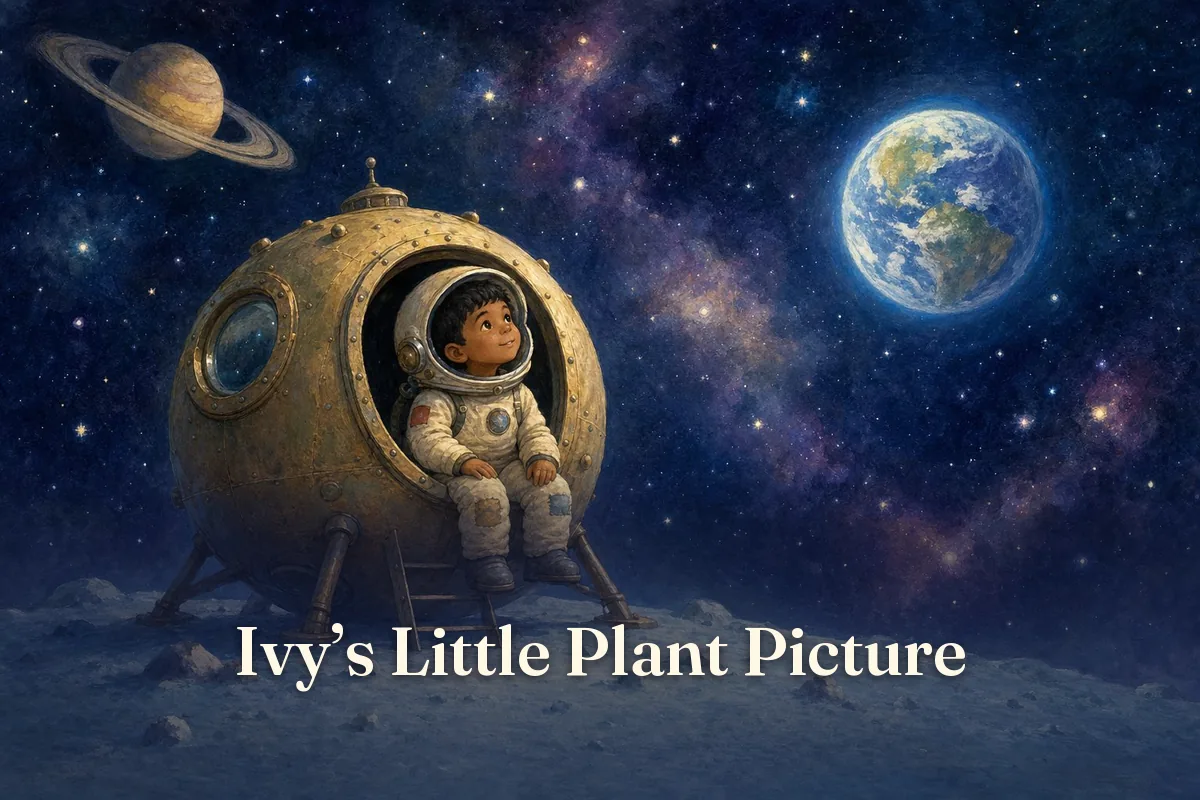
Ivy’s Little Plant Picture
Ivy is growing a tiny plant aboard the space station and wants to capture its two little leaves in the science notebook. But in microgravity, the container won’t stay put, and Ivy’s attempts keep getting in the way of the picture.
I wanted one picture of our tiny plant, but it kept floating out of the frame.
I was working in the science area aboard the space station, where small experiments rested inside clear containers. One of them held a young green plant with two leaves as little as my fingernails. We were growing it in a controlled environment, with the right water and light, so we could watch how it changed up here.
“I’m ready when you are,” Zane said. He held our camera in both hands and aimed it toward the plant.
I picked up the container carefully. The plant wobbled, though its roots were tucked safely in the growing material. I turned the container until the leaves faced the camera.
“Just a little closer,” Zane said.
I shifted my hand. The leaves slipped out of the frame.
“Whoops,” I said. “Let’s try again.”
Zane moved the camera. I turned the container back. For a moment, the plant sat neatly in the middle of the view. Then a small puff from the station’s air vents nudged the container. I reached for it, and the picture tilted toward my sleeve.
Zane lowered the camera. “That’s a very nice photo of your elbow.”
I laughed. “My elbow is not the experiment.”
I tried holding the container with one hand and pointing at the leaves with the other. But my arm stretched across the camera’s view, and I couldn’t turn the plant toward the light without twisting myself into a knot.
When I let go to adjust the camera, the container floated away. It didn’t rush. It simply sailed past my shoulder, carrying the little plant with it.
“Plant coming through,” Zane called.
I caught the container before it reached a shelf and brought it back to the work area. Nothing was hurt, but I frowned at the empty spot in the camera screen.
Objects in microgravity could float if they weren’t secured. I knew that. Still, I had hoped I could manage one simple picture with my hands.
The plant’s leaves lifted and settled as I held the container close. They looked ready for their portrait. I looked around the work area for a way to keep the container still without covering the view.
“Let’s pause,” I said. “There has to be a better way.”
Zane kept the camera pointed toward the work area while I studied the plant container. It had a clear front, a flat back, and a small rim around the top. I could hold the rim, but then my fingers showed in the picture. I could grip the sides, but my hands blocked the leaves.
“Maybe we can set it down,” Zane said.
I tried. The container touched the work surface, then lifted away as soon as I released it. It floated slowly toward the edge of the station strap nearby.
I caught it again. “Not quite.”
My cheeks felt warm, even though no one was watching but Zane and the tiny plant. I wanted the picture to show the leaves clearly in our science notebook. I didn’t want to bump the plant or leave it drifting around while we tried again.
Then I noticed a soft loop on the side of the container. I had seen it before, but I had been so busy gripping the container that I hadn’t thought about what it was for.
“Wait,” I said. “That loop can hold it.”
I brought the container beside the station strap. The strap was made for keeping equipment in place. I slid the soft loop over it, making sure the strap held the container without pressing on the clear front.
The container stayed where I put it.
I gave it the tiniest turn. The leaves faced the light, and the clear side faced Zane’s camera. Nothing covered the plant. Nothing floated away.
Zane raised the camera again. “That looks like a real plant portrait.”
“Let’s see,” I said.
He held the camera steady while I checked the view. The two little leaves filled the center of the frame. Behind them, the growing material looked dark and tidy. A narrow stripe of light rested along one leaf’s edge.
“Ready?” Zane asked.
I checked the loop and strap once more. They held the container securely, and the plant sat safely in its spot.
“Ready.”
Zane pressed the button. The camera made a quiet click.
We looked at the picture together. There it was: our tiny plant, clear and bright in the frame, with no sleeve, elbow, or floating container in sight.
“I think we got it,” I said.
And this time, the plant stayed right where it belonged.
Zane and I added the picture to the science notebook. The screen showed the date, the experiment name, and our little plant looking as if it knew it had done a fine job sitting still.
I wrote a short note beneath the photo: “Two leaves. Container secured by its loop. Plant turned toward the light.” I read it aloud, then added, “Photographer’s elbow not included.”
Zane gave a quiet chuckle. “That belongs in the next edition.”
I checked the plant one last time. The soft loop rested over the station strap, and the container stayed safely in its place. The leaves were still lifted toward the light. I didn’t touch them. They had everything they needed for now.
Around us, the science area hummed with the small sounds of the station. A fan whispered. A page in the notebook floated at its corner until Zane tucked it under the cover. Beyond the work area, our home moved along its steady path above Earth.
I looked at the photo again. The plant seemed so small beside the wide station window. It was growing aboard the station in a carefully controlled space, where it could drink, stretch, and make new leaves while we watched.
“Do you think it’ll be bigger next time?” Zane asked.
“I hope so,” I said. “Maybe one leaf will be wide enough to cast a little shadow.”
I pictured the next photograph: the same clear container, the same strap holding it safely, and a plant with a bit more green to show us. There was no hurry. The plant could grow at its own pace, and we could check on it when the next notebook page was ready.
For now, our picture was finished. I closed the notebook and left the container secured beside the experiment, where the light reached its leaves. Then Zane and I floated away from the work area, speaking softly about the two little leaves in our photo.
As I settled into my sleeping space, I remembered how the container had sailed from my hands, and how the tiny loop had helped me find the answer. I imagined our plant growing a little more before its next portrait, safe in its spot among the quiet stars.
Good to know
- In microgravity, unsecured objects can float.
- The plant is grown in a controlled environment with water and light.
- Ivy secures the plant container to a station strap using its soft loop.