Sun and Star Story
Marigold’s Picture of Night
Marigold wants to make Kit a picture of the moonlit sky, but her bright rays keep washing out the colors. As they try different ideas, the two friends work out how to paint the night together.
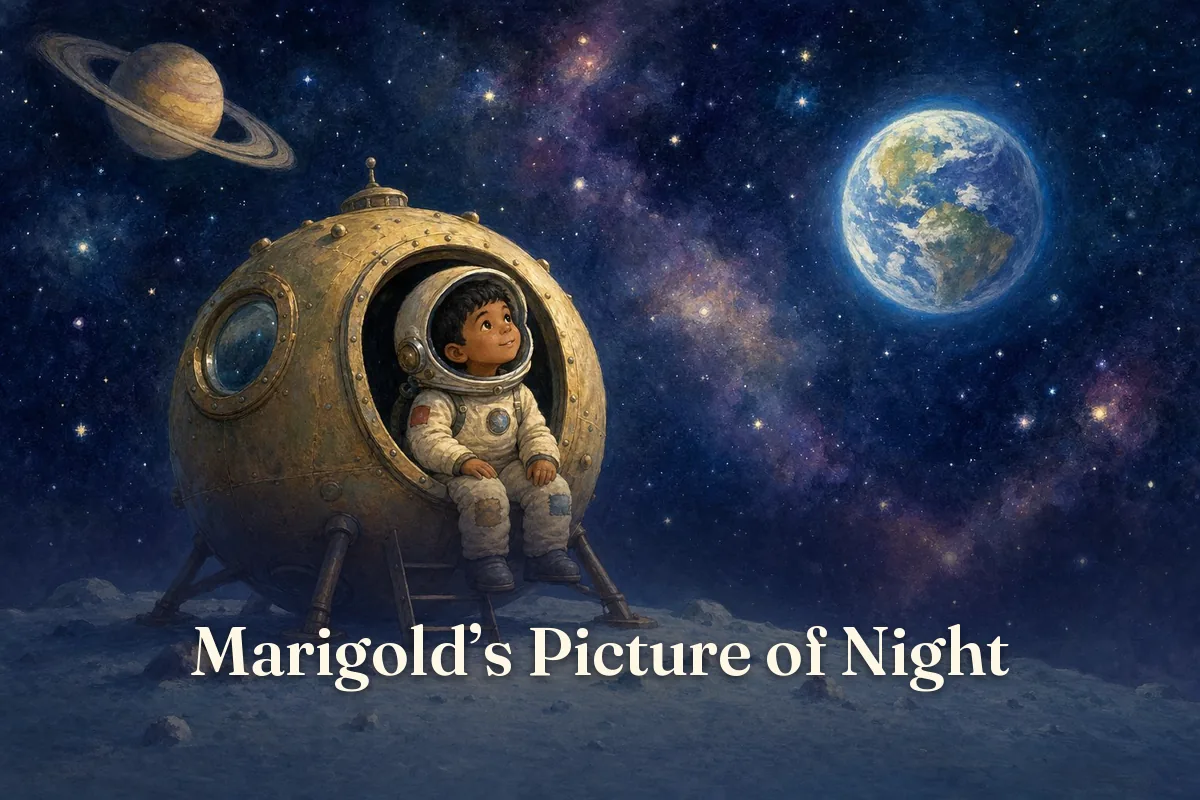
“How do I paint a dark sky?” Marigold wondered, holding her brush over a pale sheet of sturdy paper.
She was a young sun, with golden rays that liked to reach into every corner. Her sky studio floated among the stars. It had a wide sheet of paper clipped to an easel, a jar of glowing colors, and a round window where the moon peeked through.
Beside her stood Kit, a tiny space traveler with a silver backpack and a little map tucked in one pocket.
“I want to take a picture of the moonlit night home,” Kit said. “My family has never seen your side of the sky.”
“I’ll paint it just for you!” Marigold promised.
She dipped her brush into the jar. The colors inside—moon-white, comet-blue, and star-gold—swirled like sleepy little ribbons. Marigold leaned toward the paper and shone her light to see where to begin.
Whoosh! The whole sheet turned bright as a breakfast table in the morning. The moon vanished. The stars vanished. Even the dark paint looked pale.
Kit squinted. “I can’t see the night anymore.”
Marigold pulled back. “Oh! My light is getting in the way.”
“Could you paint the stars first?” Kit asked. “Maybe they’ll show up on top.”
Marigold liked that idea. She dabbed three tiny gold dots onto the paper. But with her shining face right above them, the dots disappeared in the glare.
“Perhaps we should move the paper nearer the window,” Kit said. “The real night might help.”
They scooted the easel across the studio floor. Marigold gave the paper a bright look. It lit up again, and the stars outside the window seemed to disappear behind its shine.
Marigold lowered her brush. “We’ve tried painting the stars first, and we’ve tried moving the paper. What do you think I should try next?”
Maybe you would suggest using the darkest color first. Maybe you would tell Marigold to turn her light away. Kit listened to your ideas, and Marigold considered them carefully.
“I’ll test one thing at a time,” she said. She picked up the jar of comet-blue and studied the paper. “If I can make the night stay dark, Kit will have a picture to carry all the way home.”
Marigold dipped her brush into the comet-blue. She painted a wide stripe across the paper, then another beneath it. The color looked deep and beautiful—until she leaned in to admire it.
Her light spread over the paint. The blue turned pale, and the edges of the moon disappeared again.
“Still too bright,” Marigold said. “I can’t paint a night while I’m shining right on it.”
Kit peered at the paper. “What if you turn your face toward the wall while you paint?”
Marigold tried. She turned around and reached her brush behind her. The paper stayed dark, but her brush slid too far. It made a long blue stripe right across the place where the moon should go.
“Oops!” Marigold giggled. “That moon would need a very long hat.”
Kit giggled, too. He held the easel steady while Marigold turned back. “We need a plan that keeps your light away and lets you see where your brush goes.”
Marigold looked at the paper, the round window, and the jar of colors. Then she looked at the little moon outside. A new idea took shape.
“I can paint the dark sky first,” she said. “Then I’ll turn my light away before I add the stars. The stars can glow by themselves!”
“Let’s try it,” said Kit.
Marigold painted the whole sheet with comet-blue. This time she stood beside it, so her rays fell on the studio floor instead. The color stayed dark. Kit watched the edges and said, “A little more near the corner!” Marigold followed his directions, and soon the paper held a wide blue night.
Then she turned toward the wall. Kit took the brush and dabbed tiny gold dots onto the sky. Marigold listened as he described where he placed them: “One near the top, two beside the moon, and three making a crooked little kite.”
When Kit finished, Marigold turned her light toward the window. The gold dots glowed against the dark blue. She added a round moon-white moon, carefully, with Kit guiding her hand.
“There!” Kit said. “That’s the night I wanted to take home.”
Marigold beamed—but she kept her rays pointed away from the picture. It was finished, and the moon and stars stayed right where they belonged.
Kit stepped back to admire the picture. The crooked little kite of stars seemed ready to sail across its blue sky.
“I can almost hear the quiet out there,” he said.
Marigold looked through the round window. The real moon hung among the stars, and the dark sky stretched far beyond the studio. It looked peaceful, like a wide place where everything could rest.
“Your picture has the moon from my window,” Marigold said, “and stars made with your own hands.”
“And comet-blue from your jar,” Kit added. “It belongs to both of us.”
Marigold lifted the finished sheet from the easel. She folded it carefully, picture side out, so the painted stars wouldn’t rub together. Kit slipped the folded picture into the flat pocket on his silver backpack.
“Now my family can see what your night looks like,” he said. He gave Marigold a small wave. “I couldn’t have carried a piece of your night home without you.”
“You helped me make it,” Marigold replied. “I’m glad you stayed to paint.”
Kit walked to the studio door, then paused to look once more at the bright little marks showing through the fold. “Those stars are coming with me.”
“They know the way,” Marigold said.
Kit set off along the quiet star path, his backpack snug against his shoulders. The picture rested inside, safe and still. Marigold watched until his silver boots were no bigger than two dots in the window.
Then she turned back to the studio. The brush lay beside the jar of glowing colors, and the easel stood empty. She tidied the brush and set the jar on its shelf. After that, she dimmed her rays until the room grew calm and the real night outside became easy to see.
The moon kept its place above the window. Far away, Kit carried Marigold’s picture through the dark, where its tiny stars gleamed on the folded paper as the real sky grew quiet outside the studio. Marigold rested beneath the familiar stars, pleased that her light had helped make a picture—and that, for tonight, it could be still.