Astronaut Story
Rosa and the River Below
Rosa is floating beside a space station window when she sees a river winding through fields and hills below. As she tries to photograph it before clouds drift in, an unexpected pale patch keeps appearing in her picture.
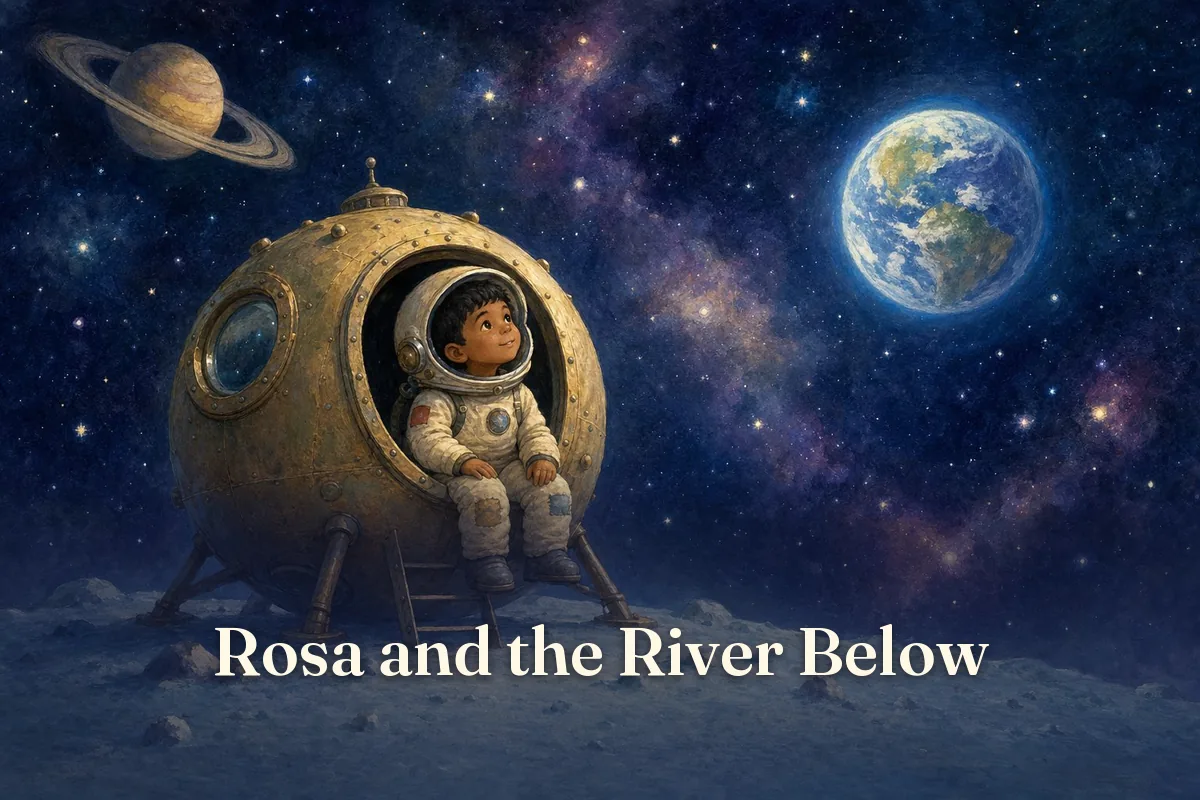
“There it is!” Rosa whispered, pointing at the shining river below.
She floated beside a wide window on the space station, one hand holding the frame and the other reaching for her camera. Far beneath her, a bright river curved through green fields and brown hills. It looked like a silver ribbon someone had laid across the land.
Rosa had seen the river before, but never from just this angle. The station was passing over it now, and soon it would slide behind a bank of clouds. She wanted a clear photograph to keep beside the window, where she could find the river again whenever she liked.
“Hold still, little river,” she told it.
The river, of course, kept winding along.
Rosa tucked her feet beneath a strap so she could stay in place. Nearby, a soft cloth floated in a loop beside the camera. She caught it and set it on a small ledge, then lifted the camera to her eye.
The window framed a marvelous view. Earth curved away at the edges, blue and green beneath thin white clouds. The river made one shining bend, then another, as if it were drawing a secret message across the land.
Rosa aimed carefully. She lined up the camera with the biggest bend and pressed the button.
Click.
She checked the picture. The river was there, but a pale patch covered part of the view. It lay across the image like a ghostly square, hiding one of the river’s turns.
Rosa tilted the camera. The pale patch shifted.
“Hmm,” she said. “That’s not how a river is supposed to look.”
She shifted the camera in her hands until the river’s broad curve sat near the center of the frame. The pale patch moved with it.
Outside, the cloud bank crept closer. Rosa glanced from the camera screen to the window and back. She had a little time, but not much.
She rested the camera near the cloth and studied the pale patch. It seemed to come from somewhere close by, not from the distant land. Rosa looked around the quiet room, noticing the window, the camera, and the bright lamp overhead.
Rosa lifted the camera again and aimed at the river’s shining bend. The pale patch slid across the picture, covering the same spot as before.
“Maybe the window needs a wipe,” she murmured.
She took the soft cloth from the ledge and gently cleaned a small place on the inside of the window. Then she looked through the camera.
The pale patch was still there.
Rosa paused. She looked at the cloth in her hand, then at the camera screen. The patch had sharp edges. It did not look like a cloud, and it did not change when the river changed. It looked almost like a tiny window floating in the picture.
She lowered the camera and looked around the room. The station’s ceiling lamp shone brightly. On the dark camera lens, Rosa could see a faint square of light.
“Oh!” she said. “The room light is reflecting in the camera.”
She moved the camera closer to the window. The pale patch grew smaller, but it did not disappear. She tried turning her shoulder to block the lamp. The patch shifted again, and for one moment the river’s middle bend appeared clearly.
“There you are,” Rosa whispered.
Then her elbow slipped from the window frame, and she floated a little sideways. She caught the handhold with one hand, steadying herself. The camera bobbed in her other hand, but she kept it safe. The river was still below, and the clouds were drawing near.
Rosa looked up at the lamp. Its little switch was beside the doorway. She could dim it without leaving the window for long. She hooked one foot under the strap, held the camera against her chest, and reached for the switch.
The room grew less bright. Rosa returned to the window and raised the camera. The pale patch was gone.
She lined up the river’s long curve, the green fields, and the white cloud edge. The picture looked just as her eyes saw it: clear, bright, and full of winding turns.
Rosa pressed the button.
Click.
She checked the screen. The river flowed across the photograph, every bend in view. Rosa gave a quiet, pleased “Yes,” and tapped the camera’s print button. A small paper copy slid from a slot along its side. She tucked it safely beneath the camera strap while the station carried her onward.
Rosa turned the camera screen toward the window and compared the picture with the real view. The river below had shifted a little, but she could still see its bright curve between two fields.
“It’s a good one,” she told the river.
The river made no reply. It simply slipped beneath the approaching clouds, taking its shining turns out of sight. Rosa watched until the last narrow piece disappeared. She did not feel in a hurry to look away. There was plenty to see: the pale clouds moving over the land, the deep blue beyond them, and the quiet curve of Earth at the edge of the window.
When the clouds covered the river, Rosa looked down at her paper photograph. The image held the moment she had wanted—the long bend, the smaller turn beside it, and the patchwork fields all around. She brushed one corner of the paper with the soft cloth, though it was already clean.
The camera rested on the ledge. The room light stayed dim, and its reflection no longer crossed the window view. Rosa liked the calmer room. It made the outside seem even wider, as if the station had opened a little more space for looking.
A magnetic clip was fixed to the metal panel beside the window. Rosa slid the photograph beneath it, where it stayed in place. She nudged one edge until it lined up neatly with the window frame.
“Now I can visit whenever I want,” she said.
She settled beside the picture and watched the real Earth pass below. The clouds moved slowly over the fields. Somewhere beneath them, the river kept winding through its valley, whether Rosa could see it or not.
For a while she stayed quiet, letting the window be a window and the photograph be a small reminder. The station hummed around her, steady as a faraway lullaby. She curled her fingers around the ledge and followed the cloud tops as they drifted by.
The river was hidden now, but its bright path waited beneath the clouds. Beside the window, Rosa’s picture held its place as she watched the world turn peacefully on below.
Good to know
- From orbit, Earth’s rivers, fields, and clouds can be seen through a space station window.
- A bright room light can reflect in a camera lens and create a pale patch in a photograph.
- Astronauts use handholds and foot straps to help steady themselves in microgravity.