Owl Story
Clover’s Little Hoo
Clover has settled into a new tree and hopes to meet the owl who calls from a nearby maple. But she isn’t sure how loudly to answer—or whether the other owl wants company.
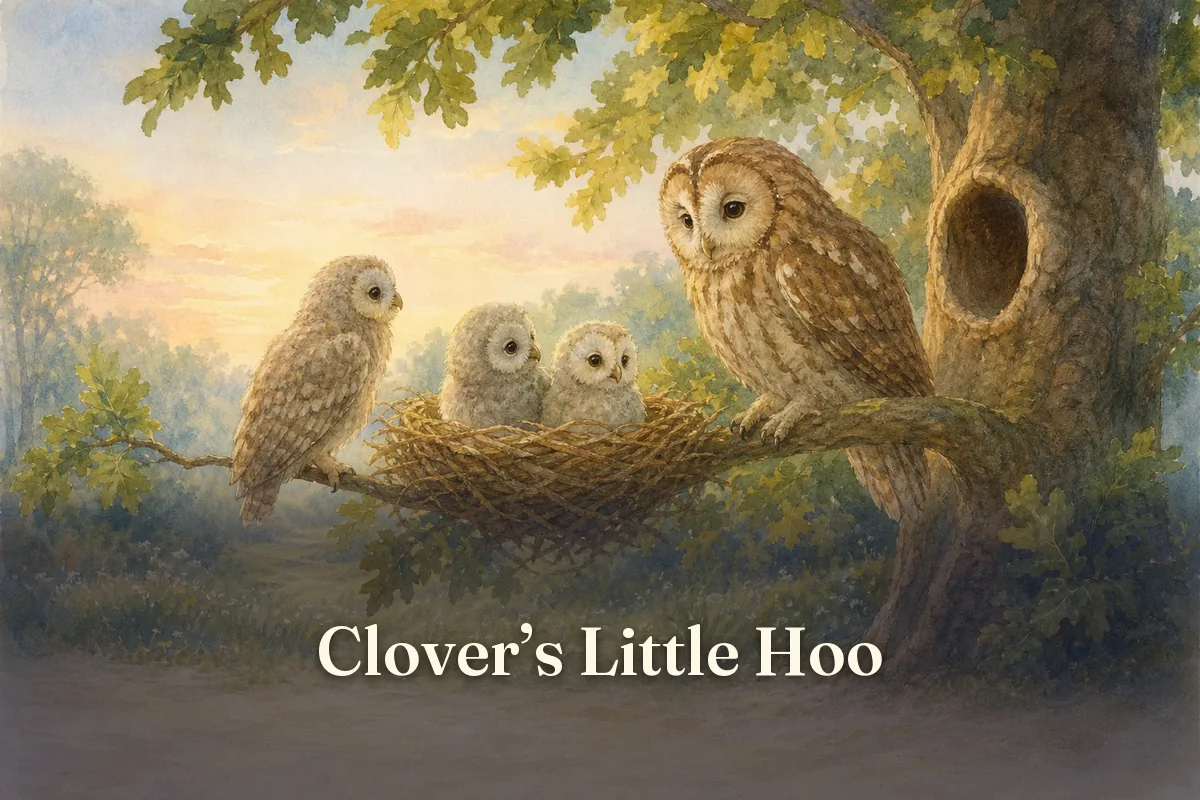
“Hoo,” came from the next tree. Clover drew a breath. “Hoo?” she answered.
Her little call slipped out and landed somewhere among the leaves. Clover waited. A twig creaked above her, and a pair of sparrows chattered far below, but no owl answered.
Clover had just begun resting in this part of the woods. Her new tree was a tall oak with a hollow nook for shelter and a branch broad enough for both feet. Across a narrow patch of ferns stood another tree, an old maple with a leafy roof. That was where the call had come from.
“Hoo,” it had said. Not too loud. Not too low. Just right for wondering who was nearby.
Clover tipped her head toward the maple. She wanted to meet the owl who lived there. She pictured saying hello, then asking which branch had the best view of the woods. But a question seemed like a big thing to send across the space between the trees.
She tried again. “Hoo?”
This time, she made the sound so small that even she could barely hear it. A bead of dew shook loose from a leaf and plopped onto her wing.
“Oh,” Clover whispered. “That didn’t travel far.”
She tucked her feathers close and watched a beetle trundle along the bark. The woods were busy with daytime sounds: a squirrel fussing over an acorn, leaves rubbing together, and a woodpecker tapping somewhere beyond the ferns. Maybe the owl in the maple couldn’t hear her. Maybe he was resting. Maybe he didn’t want company.
Then, from the next tree, came another call.
“Hoo-hoo.”
Clover’s ears lifted. The sound was friendly, but it wasn’t a shout. It floated over the ferns, paused beside her oak, and seemed to wait.
Clover shifted her toes on the branch. She could answer in a way that felt like her. It didn’t have to be loud or fancy. Still, she wanted to know who was calling.
She looked toward the maple and shaped her beak for one more try. Around her, the leaves held still, as if the whole patch of woods were listening.
Clover let out a careful, tiny “Hoo.” It floated over the ferns toward the maple.
From the maple came a soft “Hoo?” Hank had heard her after all.
Clover blinked. The other owl hadn’t called loudly at all. He had made a gentle sound, like he was leaving plenty of room for her to answer.
A smile warmed Clover’s face. “Oh,” she said. “I can greet him my way.”
She gave a little two-part call: “Hoo—hoo?” The first note was low. The second rose just a bit, like a question peeking around a tree trunk.
A rustle answered from the maple. Then an owl stepped onto a branch where Clover could see him. He was brown and cream, with round eyes and a leaf stuck neatly to one shoulder.
“Hoo-hoo,” he called. Then he dipped his head.
Clover copied his bow. “Hoo!”
The owl answered, “Hoo-hoo?”
“Hoo-hoo-hoo,” said Clover, her last note barely more than a breath.
The owl gave a quiet chuckle. “I’m Hank,” he called. “I heard you. Your little hoot found me.”
Clover’s shoulders loosened. “I’m Clover. I thought I had to call louder.”
“Not with me,” Hank said. “Owls use calls to communicate with other owls. Some calls carry far, and some are meant for a nearby friend.”
Clover tried a new greeting, a short “Hoo?” followed by a cheerful “Hoo!” Hank answered with two notes of his own. Their calls crossed the small space between the trees, taking turns like two friends passing a pebble.
They talked about the cool shade beneath the maple and the wide view from Clover’s oak. When Clover asked if they could rest nearby, Hank nodded.
“Gladly,” he said, and settled on a branch facing her tree.
For a little while, Clover and Hank kept their conversation going.
“Hoo?” asked Clover.
“Hoo-hoo,” answered Hank.
Clover tilted her head. “Hoo!”
Hank’s feathers lifted with a quiet laugh. “Hoo!” he replied.
Their calls grew shorter as the woods grew still around them. A squirrel padded down the oak trunk, carrying an acorn in both paws. It stopped when it noticed Clover, then hurried on without a sound. Clover and Hank watched it go.
“Good acorn,” Clover whispered.
“Hoo,” Hank agreed.
The leaves above them stirred, and a stripe of daylight slipped between the branches. It rested on the ferns, then moved slowly across the forest floor. Clover found a comfortable spot on her broad oak branch. Hank tucked himself onto his maple limb, close enough that they could see each other through the leaves.
Clover felt glad she had called, even when her first hoot had been too quiet to travel. It had helped her discover that a greeting didn’t need to be loud to be heard. Hank had listened for her small voice, and she had listened for his.
“Are you still there?” Clover asked with one soft note.
“Right here,” Hank answered.
She gave a little “Hoo-hoo.”
He replied, “Hoo-hoo.”
Then they let the quiet return. It wasn’t an empty quiet. It held the creak of branches, the hush of leaves, and the comfort of knowing another owl rested close by. Clover drew her feathers around her feet. Across the ferns, Hank settled his head beneath one wing.
The bright patch on the forest floor grew narrower as leaves swayed overhead. Clover listened to the woods and to Hank’s slow, easy breathing. She no longer wondered whether her call was too small. It had crossed the space between their trees, and it had brought a new friend.
One last “Hoo,” Clover murmured.
From the maple came one last “Hoo.”
Good to know
- Owls use calls to communicate with other owls.
- Some owl calls carry far, while others are meant for a nearby owl.