Mountain Trail Story
The Map Corner and the Three-Trunk Tree
Pippa, Ellis, and Maren are following clues on a mountain trail when a gust carries away a corner of their game map. With a young mountain-rescue volunteer beside them, they use the drawing and familiar landmarks to guide their search.
The map lay open on the picnic blanket when a gust snatched one corner and sent it sailing over the grass. It landed somewhere beyond a low hillock.
“Hey!” cried Pippa, reaching after it.
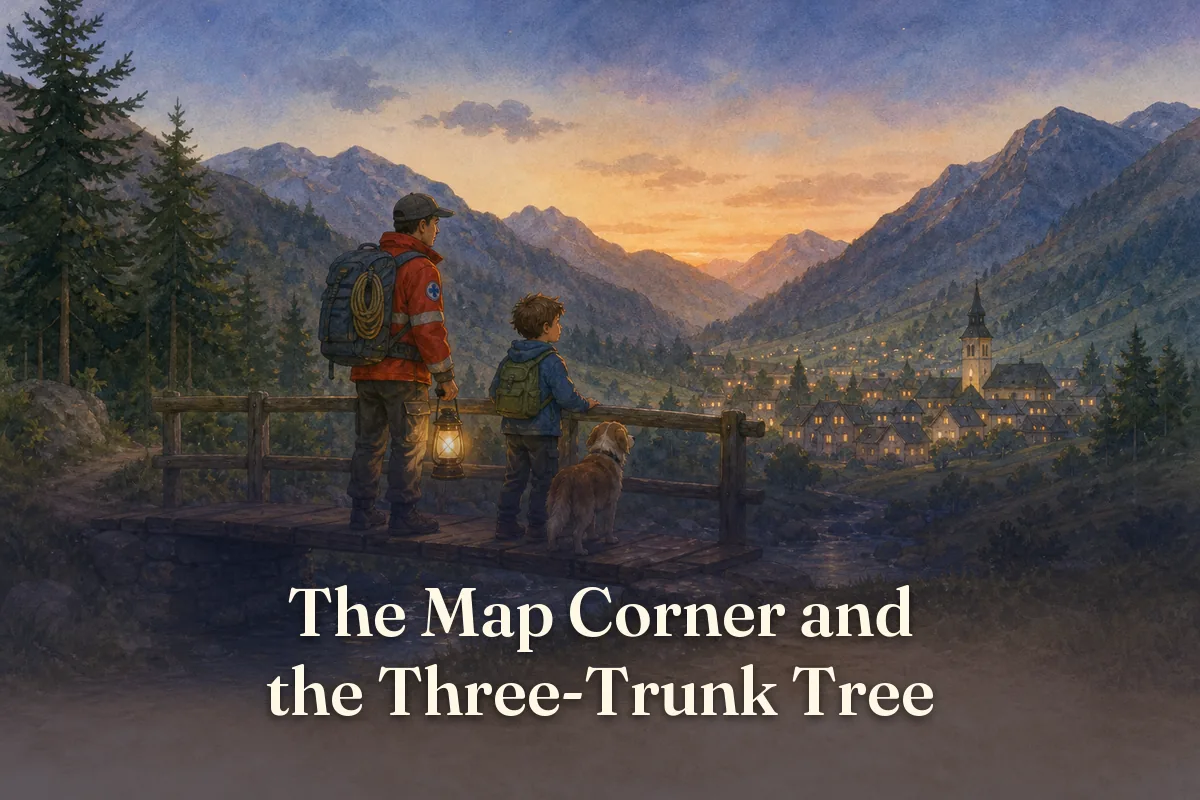
I was a young mountain-rescue volunteer, helping at the picnic clearing beside the nature trail. The children had invited me to join their map game, and I hoped we could find the last clue before picnic time was over.
“Let’s begin where the map begins,” I said. “At the information board.”
The board stood beside the trail entrance. Its map showed a creek, a broad boulder, and trees along the path. The children’s game map showed the same landmarks, with a riddle at each stop.
Pippa, her brother Ellis, and their friend Maren had already found two cards. The creek clue had led them to the boulder, where they found another card beneath a flat stone. Now they were trying to solve the last part of the game.
“The dotted path ends at that tree,” Maren said, tracing the map. “But the clue was on the corner that blew away.”
“Maybe we can still work it out,” Pippa said. “We have the drawing.”
The picture showed a tree with three trunks rising from one wide base. The corner was supposed to hold the written hint: it would describe that tree and say what to look for there. The children searched the grass nearby, but the paper was nowhere in sight.
“Let’s use the landmarks we still have,” I said. “We can follow the map carefully and see where the drawing leads.”
“What do we know about the tree?” I asked.
“It’s tall,” Ellis said.
“Leafy,” Pippa added.
Maren studied the picture. “And it has three trunks that start near the ground.”
“That’s the detail that can help us,” I said. “We don’t need to check every tree.”
Pippa remembered seeing one from the trail. She pointed past the boulder, where the path curved. We stayed on the marked trail, with the children leading the search and me close behind.
At the bend, a cluster of trees stood beside the path. One had a branch that forked high above the ground, but its trunk was still one trunk.
“Not that one,” Maren said. “The drawing splits at the bottom.”
We followed the curve past a patch of ferns. There, beside the trail, stood a broad tree whose base divided into three sturdy trunks. They rose side by side like friends standing together.
“There!” Pippa called.
Ellis checked the picture. “That’s the tree.”
I asked them to look around without tugging at the bark or stepping off the path. Maren spotted a card in a wooden holder beside the trail marker. She read it aloud: “You found the tree! Now follow the trail back to the blanket for your picnic.”
The children grinned. The map’s drawing had helped them find the right tree, and the card gave them the next step: return to the clearing.
“Good map-reading,” I said. “You noticed the important detail and figured it out together.”
We turned back along the marked trail. The missing corner could wait until after the picnic.
The blanket was still in the clearing, held down by a water bottle, a folded jacket, and the basket. Ellis placed the card in the middle like a treasure.
“We found the creek, the boulder, and the tree with three trunks,” he said.
“And we followed the trail back,” Maren added.
Pippa opened the basket and passed around apple slices. As we ate, the children retold the game, taking turns to remember how each clue had led to the next. They especially liked how the little tree drawing had helped us choose the right one.
“What about the map corner?” Pippa asked.
We looked under the blanket and through the nearby grass. At last, Maren spotted it beside the hillock, caught against a tuft of grass. The paper had a crease, but the words were clear. They read: “Find the tree with three trunks. A card there will show you the way back to the picnic blanket.”
“So the corner told us which tree to find,” Ellis said, “and the card told us to come back here.”
“Exactly,” I said. “The two clues worked together.”
We fitted the corner back onto the map. Ellis smoothed the crease with his palm while Pippa lined up the edges. Then Maren folded the map along its old lines, leaving the drawing of the three-trunk tree easy to see.
The trail markers stood quietly beyond the clearing. We had nowhere else to go, so we finished the apple slices, the last sandwich, and a few crackers from the bottom of the basket.
A few leaves quivered above us as we rested, while the folded map stayed tucked beside the basket. Birds called from somewhere along the mountain trail, and the children leaned back on their hands to listen.
When the picnic was done, we packed the cups and crumbs. The children carried the map together, and I walked with them to the edge of the clearing. Far down the path, the three-trunk tree was easy to remember.
That evening, when I told the story again, I remembered how one small drawing had led us to the answer—and how good it felt to solve the trail together.
Good to know
- The group stays on the marked trail while searching.
- A map can help identify places by showing landmarks such as a creek, a boulder, and trees.