Steam Train Story
Ruby’s Little Hello
Ruby’s whistle is made for railway signals, but she would like a quieter way to say hello to the families she meets. With help from Cal and his flute, she listens to the familiar sounds of her train and wonders how they might become a friendly greeting.
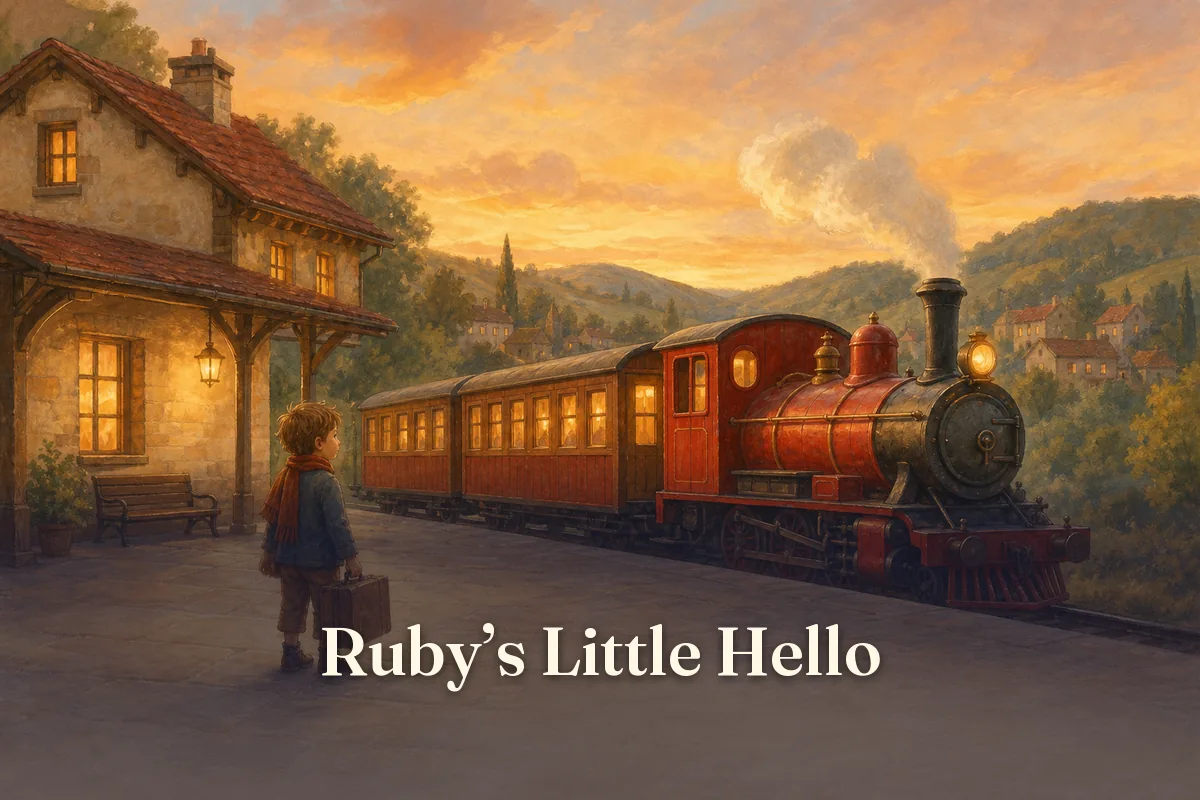
Ruby had a whistle as big as a mountain. When it was time for the train to leave the station, she gave the railway’s departure signal.
“Woooooo-oo-oo!” it called from the hills. The sound bounced from one slope to another, then rolled past the little station where families waited beside the track.
Ruby’s wheels slowed as she stopped at the platform. “That signal echoed all across the valley,” she said. “I hope I can find a gentler way to say hello.”
A boy in a green cap waved from the platform. His name was Cal, and he carried a small wooden flute in his coat pocket. “Your whistle was a very big sound,” he said.
“It’s for railway signals,” Ruby replied. “I shouldn’t use it just to greet people. But I’d like to find a friendly hello of my own.”
“Maybe we can find the right one,” said Cal.
The little heritage railway curled through a peaceful valley, past a stone bridge and fields dotted with sheep. Ruby pulled a short train of wooden coaches. Inside, families settled by the windows, ready for a ride to the end of the line and back.
The station keeper opened the coach door, and Cal climbed aboard with his flute. Soon the train was rolling toward another small station. Ruby could see a family waiting there: two parents, a little girl, and a baby tucked in a blanket. Ruby wanted to greet them warmly and keep the valley peaceful.
“Will you help me practice?” Ruby asked Cal.
“Of course.” He took out his flute, but did not blow into it yet. “First, let’s listen to the train.”
Ruby’s wheels went click-clack over the rails. Her engine gave a steady chuff. The coaches hummed along behind her.
“Those sounds already tell people we’re coming,” Cal said. “Maybe they can be your hello.”
Ruby liked that idea. She watched the next station draw nearer and wondered how to make her train’s familiar sounds feel friendly.
“Let’s try a tune,” Cal said. He played three notes on his flute: “Dee, dum, dee.”
Ruby listened as the notes floated down the track. They were small and clear. “That sounds like a bird saying hello,” she said.
“Now listen to your wheels and chuff,” Cal suggested. “They can answer me.”
Ruby listened. Click-clack, click-clack went the wheels. Chuff, chuff went her engine. She joined in with a cheerful little puff between Cal’s notes.
The waiting family stood on the platform as the train came closer. The little girl held a paper pinwheel. Ruby remembered how her whistle’s sound had echoed across the valley.
“I won’t use my whistle for a hello,” Ruby said. “That’s for railway signals. But how can I let this family know I’m glad to see them?”
“Try your cheerful chuff,” Cal said. “And I’ll play the tune.”
Cal played softly: “Dee, dum, dee.” Ruby answered with a gentle chuff, while her wheels kept their steady click-clack.
The family smiled and waved. The baby blinked, then settled against a parent’s shoulder. The little girl’s pinwheel spun as she waved it back.
“I did it!” Ruby said. “A hello made of music and chuffs.”
“You did,” said Cal. “And you listened first.”
Ruby gave the family a pleased chuff as her train rolled beside the platform. The station keeper helped them board, and Ruby carried her new idea down the winding track.
The train rolled away from the station at an easy pace. Ruby’s wheels kept their steady rhythm, and the coaches followed through the valley.
“Click-clack,” said the rails.
“Chuff, chuff,” answered Ruby.
Cal tapped his fingers on the seat. “That’s a tune, too.”
“Can you play along?” Ruby asked.
Cal played three quiet notes on his flute. Ruby’s chuffs fitted between them, and the wheels kept time beneath the music. Children listened from their seats.
At a farm gate, a man raised his hand. Ruby greeted him with a bright, gentle chuff. Cal played a few notes, and the man waved as the train passed.
“Your hello has found its sound,” Cal said.
“I’m glad,” Ruby replied. “I can greet people without filling the whole valley with a whistle.”
They crossed the stone bridge. Below, a narrow creek slipped around smooth rocks. Cal played the tune once more, and Ruby answered with her wheels and her chuff. The sheep lifted their heads as the train passed, then went back to nibbling grass.
Soon the end-of-the-line station appeared ahead. Its lamps were lit, and the station keeper guided Ruby beside the platform. The families stayed aboard while the train paused, then Ruby started back along the track.
When they reached the little station, the family with the paper pinwheel stepped down. The girl waved to Ruby from her parent’s arms.
“Good night, Ruby!” she called.
“Good night,” Ruby puffed. Her whistle stayed quiet. A soft chuff was enough.
The train continued to the first station, where the other families and Cal stepped down. The platform grew still, and Ruby turned toward the engine shed. As she rolled around the bend, Cal’s quiet humming followed her into the evening.
Reading aloud
Read Ruby’s “click-clack” and “chuff, chuff” with a gentle rhythm, and play Cal’s three notes softly: “Dee, dum, dee.”
Good to know
- A train whistle can be used as a railway signal.
- A steam train makes chuffing sounds as it runs, while its wheels click-clack over the rails.