Rainy-Day Music Story
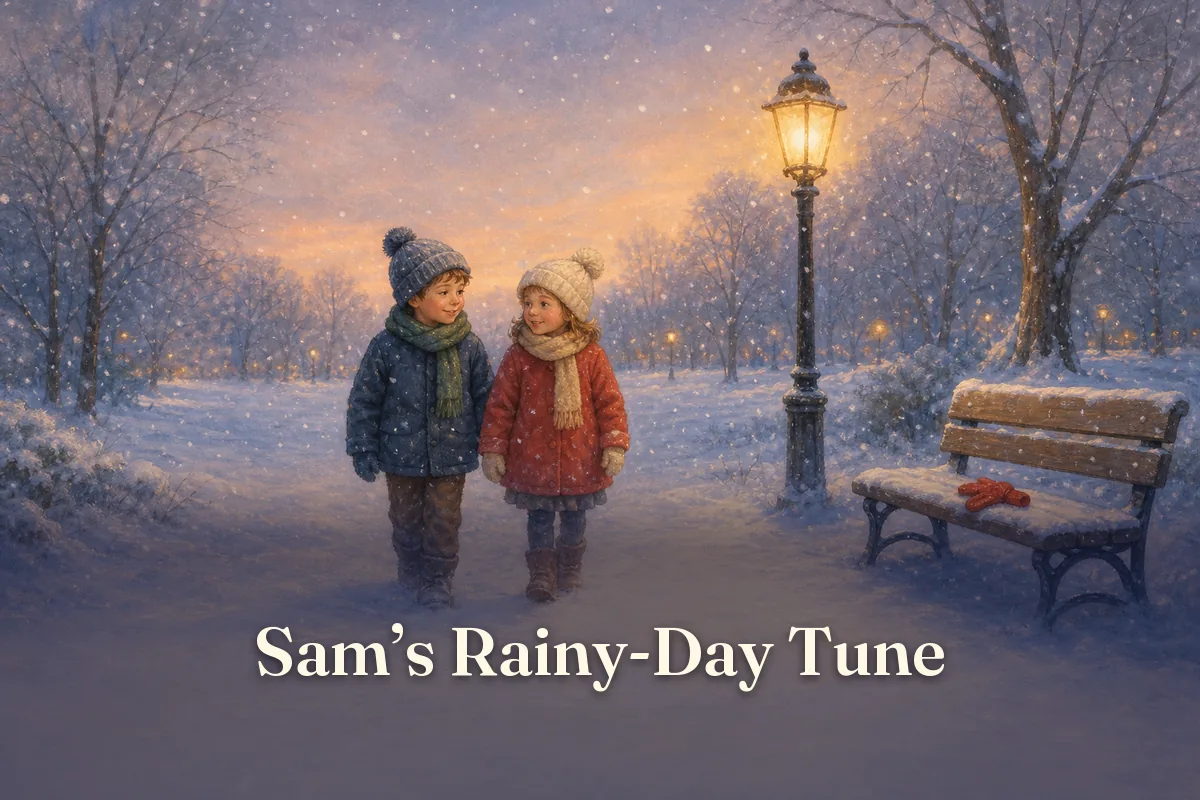
Sam’s Rainy-Day Tune
Sam sets out cups, a bowl, and a spoon to make a song for baby Bea as rain falls outside. When the sounds feel like too much, Sam listens more closely to the rain and finds a gentler way to play together.
On the rug, I set out a bowl, a spoon, and five cups. Outside, rain kept falling.
I sat beside the wide living-room window. My baby cousin Bea sat beside me in a soft blue blanket, watching water trail down the glass. Every drop made a little path, then joined another drop and hurried toward the sill.
“I’m going to make you a rainy-day song,” I told her. “A song just for you.”
Bea waved one hand. I decided that meant she was ready for a concert.
I lined up the five cups. I put the bowl in the middle and held the spoon like a drumstick. The room was cozy, with a cushion for Bea and a warm quilt over my knees.
“Ladies and gentlemen,” I announced to Bea, who was the whole audience, “welcome to Sam’s Rain Band!”
I tapped the bowl. BONG! I hit the cups one after another. Ting! Tang! TONG! Then I shook the spoon over the bowl, and it rattled like a tiny parade.
Bea blinked.
I tried a faster beat. Bowl, cup, spoon, cup, bowl! My hands flew. The cups scooted across the rug, and one tipped over with a hollow clunk.
I stopped and looked at Bea. Her eyebrows had made a little roof over her eyes. She tucked her chin into her blanket.
Maybe my song needed a bigger beginning, I thought. Maybe the rain band needed to play louder.
Outside, the rain tapped the window again. I raised my spoon.
“Pitter-pat, tap-tap, rain band, play!” I sang, and gave the bowl one mighty whack.
BONG!
Bea jumped, and the bowl rolled an inch across the rug. She didn’t cry, but her mouth turned into a tiny upside-down boat.
“Oh,” I said. “That was too much.”
I set the spoon down. For a moment, I wanted to make another big noise and win Bea back with an even bigger song. My fingers wiggled over the cups.
Then the rain tapped the window again.
Tick-tick-tick.
A pause.
Pock.
Shh-shh-shh.
I leaned closer to the wide window. Drops landed on the glass with bright little ticks. Rain on the porch roof sounded lower and rounder. Outside, the leaves caught the drops with a soft, papery patter. The rain made different sounds as it fell on different things.
I listened again. Tick-tick, pock. Shh-shh, tick.
“That’s the tune,” I whispered. “It’s not a race.”
Bea peeked over her blanket.
I moved the bowl and spoon away. The bowl was too loud for this song, and the cups were bumping into one another. I placed one cup near me and rested my hands on my knees. Then I tapped one fingertip on the cup, as lightly as I could.
Tik.
I brushed my palms over my knees.
Shh-shh.
I gave the rug a tiny pat.
Pum.
“Rain band, sway with me,” I sang in a quieter voice.
I tapped the cup once, waited, then brushed my knees. I left a little space for the roof’s pock and the leaves’ shh. The sounds outside slipped into the spaces like they had been waiting for an invitation.
Bea’s eyebrows smoothed out. Her fingers opened on top of the blanket.
I played the rhythm once more. Tik. Shh-shh. Pum. Pause.
Bea lifted both hands. I held still, careful not to hurry her.
She brought her palms together.
Clap!
It was one small clap, but it landed right in the middle of my song. My face spread into a grin. I answered with one quiet tap on the cup.
Bea clapped again, a little slower this time. Together, we played: my cup went tik, my knees went shh-shh, and Bea’s hands went clap.
We sang softly while the rain kept time beyond the window.
We played the rain song again, but we didn’t need to start at the beginning. Bea’s clap came when it wanted, and I made room for it. Sometimes she clapped after my cup went tik. Sometimes she clapped after the leaves whispered shh-shh outside.
I began to notice the little pauses, too. They were part of the music. The rain didn’t have to make a sound every second, and neither did we.
“Your turn,” I whispered to Bea.
She looked at my hands, then at the window. A drop slid down the glass and stopped beside another drop. Bea gave a tiny clap. I answered with a fingertip tap.
Tik. Clap.
Shh-shh. Pause.
The rain band swayed on.
The porch roof still made its round pock-pock sound, but now it seemed far away, like a drum playing from another room. The leaves moved gently when the breeze passed. On the window, the last drops made thin, wiggly trails.
I set the cup beside the bowl and spoon. The five cups stood in a crooked line, no longer marching anywhere. I tucked the edge of Bea’s blanket around her feet.
“Did you like our song?” I asked.
Bea rested her cheek against the cushion and gave me a slow smile. Then she lifted one hand and patted the blanket.
Pat.
I answered with a pat on my knee.
The rain’s beat grew quieter. Tick became tik. Pock became a small plink from the porch roof. The leaves gave one last shh, and then they were still.
I leaned toward Bea and sang our tune once more, so softly it was almost a whisper.
“Rain band, sway.”
When the very last drop went plink, Bea gave one tiny clap. I bowed from my place on the rug, and she smiled at my silly bow.
Then we listened together. The room held the quiet after our song, while rain trails rested on the wide window and Bea’s blanket rose and fell with her calm, sleepy breaths.
Reading aloud
Leave a little pause after the rain sounds and the words “Tik. Shh-shh. Pum.” so listeners can hear the rhythm take shape.
Good to know
- Rain sounds different when it falls on glass, a porch roof, and leaves.
- A bowl, cups, and a spoon can make different sounds when tapped.