Horse Story
Buster’s Muddy Trail
Buster is eager to rest beneath his favorite tree, but a set of muddy hoofprints catches his attention. As he follows the trail around the pasture, he begins to notice details that may help him make sense of where it leads.
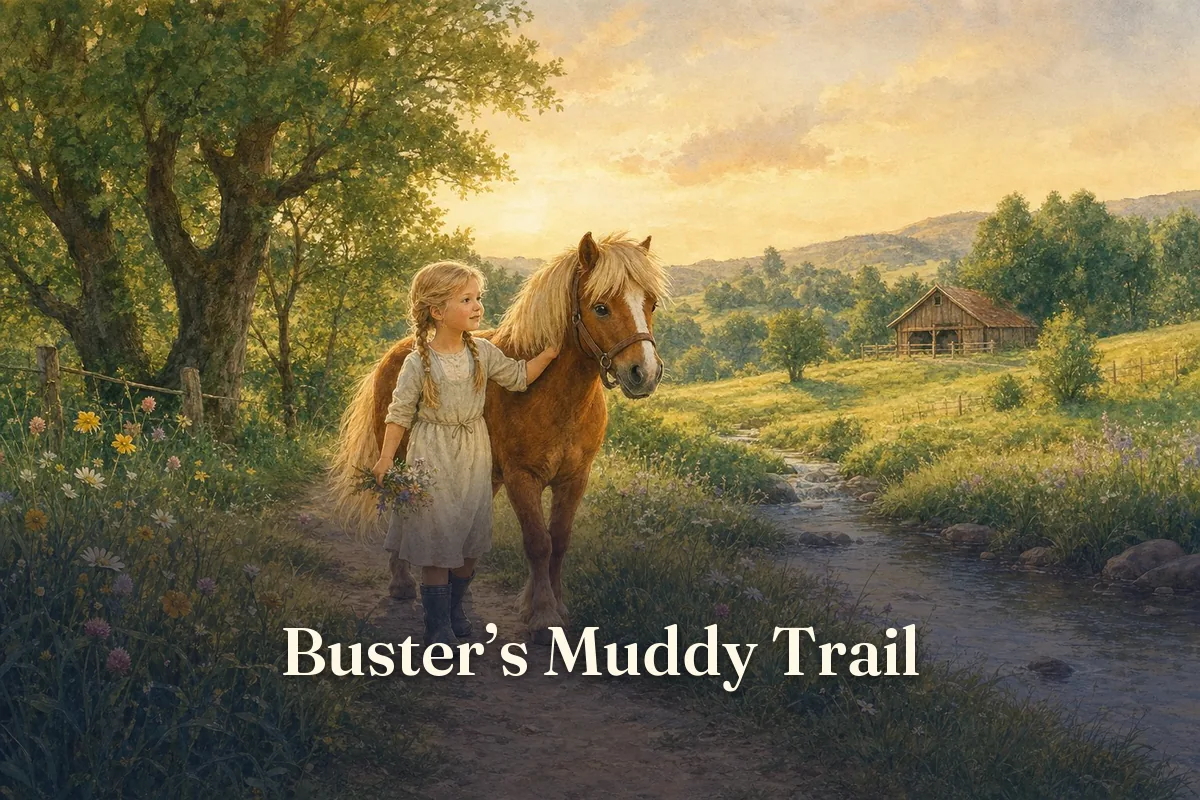
Buster found a fresh hoofprint in the mud—and it looked surprisingly familiar.
Buster bent his head until he could study the damp print. It had a curved edge, a little round dent, and a tiny notch near one side. “Who made you?” he wondered. A breeze stirred the tall grass, and Buster lifted his head. Across the pasture stood his favorite tree, wide-branched and leafy, with a cool patch of shade beneath it.
“That’s where I’m going,” he told himself. The afternoon felt warm on his back, and the grass tickled his knees. He wanted to stand quietly under the tree, or perhaps fold his legs and rest in the cool earth. First, though, he needed to find out where the muddy prints led.
They crossed the patch of soft mud and headed toward the water trough. Buster followed, placing his hooves carefully beside each mark. The prints were clear: round, deep, and close together. At the trough, they curved around the wooden legs instead of going straight toward the tree.
“That’s a funny way to get there,” Buster said. He took a sip of water. The trough gave a small, hollow glug. Then he turned after the prints again. They crossed the grass, bent around a clump of daisies, and disappeared behind tall grass that reached his chest.
Buster paused. He could still see the tree’s leafy top above the grass, but the shady spot was hidden. The hoofprints pointed away from it, toward the far side of the pasture.
“Maybe someone knows a shortcut,” he said. He followed the trail, curious now, though his favorite tree seemed farther away with every step. Behind him, the mud held each new hoofprint as neatly as a page holding a drawing. Buster didn’t look back. He was busy wondering who had walked this puzzling path, and where those tracks would lead.
The prints carried Buster along the pasture’s edge. They went past a low stone, then doubled back beside the water trough. Buster squinted at them. “This trail goes everywhere except to my tree!”
He tried to pick out the next mark. The grass brushed his sides, and a seed tickled his nose. He sneezed. “Achoo!” The tall blades wobbled, but no hoofprints appeared ahead. Buster stepped around the grass and found the trail again in a muddy patch. The prints pointed toward the tree—or so he thought. A few steps later, they curved away once more.
Buster’s ears tipped sideways. He wanted to give up and head straight across the pasture, but the marks had become a puzzle. He looked closely at the nearest print. There it was: a tiny notch near the edge, just like the little nick on one of his own hooves.
He lifted that hoof and turned it to the side. The notch matched. Buster looked from his hoof to the print, then to the next one. Each track had the same round shape and the same small mark.
Buster stared at his hoof, then at the track. “That little nick is mine!”
Buster turned around to see where the trail had gone. It looped from the mud, around the trough, past the daisies, and back again. He had been following his own hoofprints in a circle. The realization made him let out a surprised little snort.
Now he knew what to do. Buster retraced the path carefully, step by step, following the prints back toward the tall grass. At the edge of it, he stopped. The tree’s branches showed above the blades, but the ground ahead was hidden. He remembered the tree stood just beyond the thickest part.
Instead of following another muddy mark, he looked beyond the grass. He moved a few steps to the side, where the blades grew shorter. There was the tree, its broad trunk close by and its shady patch waiting beneath the branches.
“I found you,” Buster said, and walked straight toward it.
Under the tree, Buster’s ears relaxed. The leaves moved overhead with a quiet rustle, making little patches of shade shift across the grass. He let his weight rest evenly on all four legs while the cool shade spread across his warm back.
From here, the pasture looked different. The water trough sat near the mud, and the tall grass made a green wall beside it. Buster could see the route he had taken: a loop around the trough, a turn by the daisies, and then another turn. It was easy to understand now that he wasn’t standing in the middle of his own confusing trail.
He glanced at his hoof. The tiny nick was still there. “You were the clue all along,” he murmured. He tapped the ground once, gently, and listened to the soft thump.
A small bird called from the branches. Buster looked up, but he didn’t need to go anywhere. The tree held its shade around him, and the grass made a comfortable place to rest. He lowered his head and let his eyelids grow heavy.
Horses could rest while standing, and Buster sometimes did. But this patch looked especially inviting. He folded his front legs, then eased himself down onto the grass, settling with his legs tucked beneath him. The ground was cool, and the trunk stood solid at his shoulder.
A light wind brought Buster the earthy scent of wet soil and grass. Across the pasture, the muddy hoofprints began to dry in the sun. Their edges softened, though the little marks remained for a while, telling the story of Buster’s roundabout search.
He thought of how close he had come to walking in another circle. Next time, he would look at the prints—and at his own hooves, too. For now, there was nothing to solve and nowhere he needed to go. Leaves rustled softly overhead as Buster rested in his favorite patch of shade. The sky above the pasture slowly darkened.
Good to know
- Horses can rest while standing, though Buster chooses to lie down in the story.
- A horse’s hoofprints can show details such as the shape and marks on a hoof.