Snowy Owl Story
Ellis and the Faraway Hoo
Ellis, a young snowy owl, hears a quiet “hoo” coming from beyond a dip in the snowy tundra. As he calls back, the sound seems to shift from place to place, and he wonders where the other owl might be.
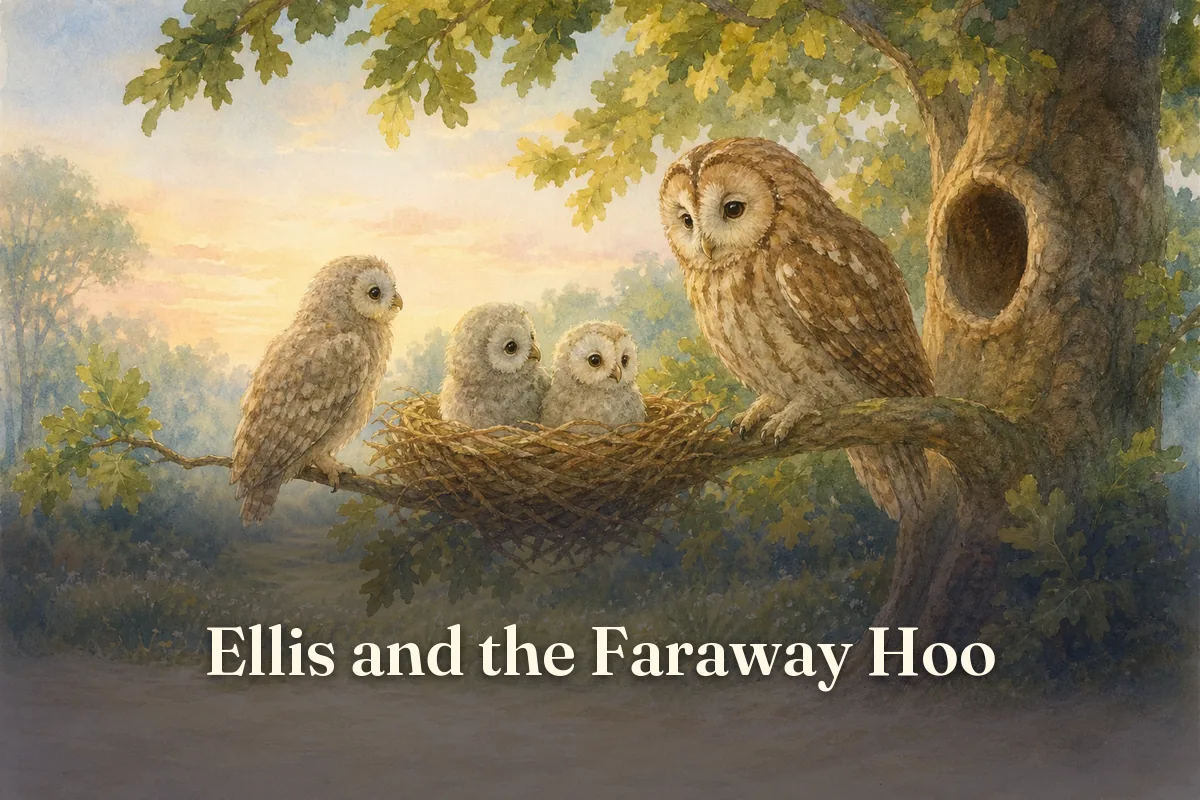
A “hoo” floated across the snow. Ellis tilted his head and listened.
He was a young snowy owl, white as the wide fields around him, with little dark marks on his wings. He perched on an open tundra ridge, where the snow lay smooth except for tiny ripples made by the wind. Ahead, the ground dipped into a shallow hollow, then rose again to a second ridge. Nothing stood tall enough to block the view—except the land itself.
“Hoo?” Ellis called.
He waited. The wind brushed past his feathers. Far away, from somewhere beyond the dip, came another sound.
“Hoo.”
Ellis sat taller. “Hello,” he said, though his owl voice came out as a small, uncertain hoo. He wanted to meet the owl who had called. Maybe the other owl was looking for a friend, too. Ellis leaned forward and peered across the hollow. He could see the far ridge, but it looked empty.
He tried again. “Hoo-hoo?”
A pause followed. Then came a reply, thin and low.
“Hoo.”
Ellis turned one ear toward it. “I hear you!” he called. But his words seemed to travel only a little way before the snow swallowed them. He watched the shallow dip, as if the missing sound might be hiding there.
The far ridge stayed quiet. Ellis fluffed his feathers, then smoothed them back down. He was not ready to give up. If the other owl could hear him, perhaps they could make a whole conversation, one call at a time.
He chose a flat place on the ridge and planted both feet. The air was still enough for listening. Ellis lifted his face and sent a clear little “Hoo!” across the tundra.
For a moment, there was only quiet. Then, from beyond the dip, came a faint answer: “Hoo.”
Ellis smiled. The other owl was still there. He just had to find a way to let the sound reach them both.
Ellis tried a longer call. “Hoooo!”
The answer came back, so faint he almost mistook it for the wind.
Ellis listened closely. The sound seemed to come from his left, so he shuffled left along the ridge and called again.
“Hoo-hoo!”
This time the reply seemed to come from the right.
Ellis blinked. “You’re moving around!” he called, though he could see no one on the far ridge. From his perch, the shallow dip hid the lower part of the opposite slope. The land bent the sound, making it seem to come from different places.
Ellis walked to the edge of the ridge. The hollow below was wide and quiet. He leaned forward, then stepped back. He did not want to tumble into the dip just to chase a sound. Instead, he studied the far ridge. It curved gently, with a low bump near one end. Perhaps the other owl was standing behind it.
“Hoo?” Ellis called, softer now.
A reply floated across: “Hoo.” It was quiet, but it was there.
Ellis turned toward the sound and took a few steps along his own ridge. From there, the low bump on the far ridge shifted out of the way. A white shape appeared above the snow.
Ellis held still. Two dark eyes looked back at him. The other owl stood on the far ridge, not far from the low bump. It had been there all along.
The owl tipped its head.
“Hoo,” came the call.
Ellis understood. The sound had reached him every time, even when it seemed to fade away. The hollow and the ridges had made it hard to hear clearly, but the owl had not stopped answering.
Ellis straightened. He chose not to fly across the broad hollow while the other owl was still a stranger. For now, he could send one good greeting, clear and kind.
He opened his beak and called, “Hoo!”
His call traveled over the shallow dip. It crossed the snow, reached the far ridge, and came back with a bright, answering “Hoo!”
Ellis gave a small bounce on his feet. “I heard you!” he called.
“Hoo-hoo!” answered the other owl.
Ellis listened until the last part of the reply had faded. Then he answered with two hoos of his own. The calls went back and forth, not loud, not hurried. One belonged to Ellis on the near ridge. One belonged to the owl on the far ridge. The open tundra carried them between the two snowy places.
The other owl raised one wing, then tucked it close again. Ellis raised his wing in return. They had not asked each other’s names. For now, the greeting said enough.
The wind moved across the ridge in a long, quiet sweep. It lifted a few loose feathers along Ellis’s shoulder and pressed them flat again. He settled onto his feet and looked toward the far side. The other owl was still there, a white shape against the snow, with dark marks on its wings like Ellis’s.
“Hoo,” called Ellis, very gently.
“Hoo,” came the answer.
As the sky dimmed, their calls dwindled to little sounds across the white land. Ellis tucked his beak beneath his feathers. Across the dip, the other owl found a comfortable place on its own ridge and did the same. Neither owl had crossed the hollow, but neither felt alone now.
For a little while, Ellis listened to the quiet around him: the hush of snow, the passing wind, and the distant sound of his new neighbor shifting on the far ridge. Then the other owl sent one last, small “Hoo” across the open land.
Ellis answered with a sleepy “Hoo,” and two small silhouettes rested on two separate ridges while the calm evening held their calls.
Good to know
- Snowy owls have white feathers with dark markings.
- Open tundra ridges and hollows can affect how sounds seem to travel.