Owl Story
Wrenna’s Sunrise Search
Young owl Wrenna wants to share her favorite sunrise view with her friend Pip, a chipmunk. But in the dim woodland, her mottled feathers blend into the bark, and the rustling leaves make it hard for Pip to locate her.
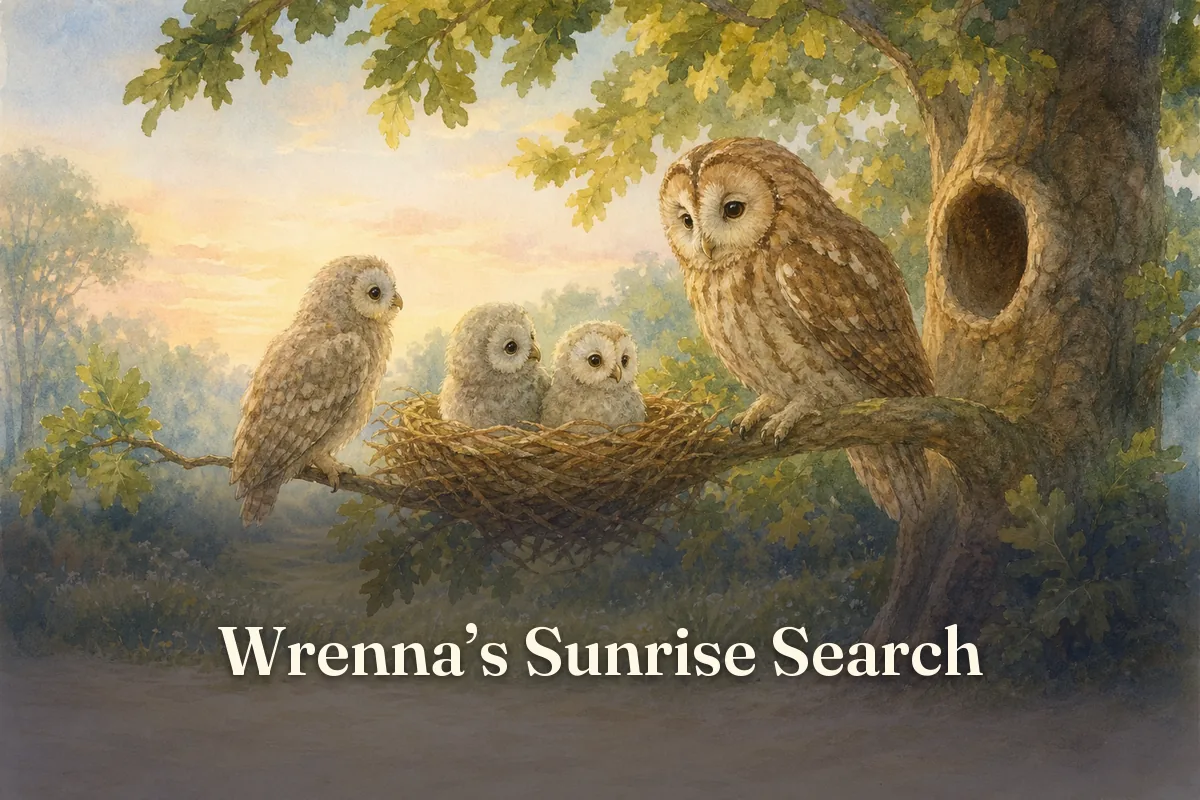
In this storybook woodland, even owls and chipmunks could be friends and share the trees safely.
Wrenna, a young owl, perched high in her favorite tree and looked toward the eastern edge of the woods. She loved watching the sunrise from her branch, where she could see the clearing and the treetops. She loved sharing the view even more.
“Come up and see the morning with me, Pip!” she called.
Pip the chipmunk stood below, his tail curled over his back. “I’m coming! Just show me where you are.”
The woodland clearing was still dim with early morning. Bark made dark stripes on the trunks. Leaves lay in little heaps, and branches crossed overhead like a patchwork roof. Here and there, a branch caught the first pale light of dawn.
Wrenna fluttered to a nearby branch and called again. A breeze stirred the leaves, making them shush and rustle all around Pip.
“Was that you by the pine?” he asked.
“No, I’m by the oak!”
Pip scampered to the oak and looked up. He saw a knot in the bark, a curled leaf, and a patch of lichen. He did not see Wrenna.
Wrenna leaned forward. Her feathers were mottled brown and gray, with little marks like the bark beneath her feet. Many owls have feathers that help them blend in with their surroundings. Wrenna’s feathers were very good at it—even when she wanted to be found.
“Over here!” she called.
Pip pivoted beneath the branches, searching in the direction of each call. Leaves rustled all around him. Wrenna watched his nose point first one way, then another.
The sun was on its way, and the favorite branch still waited above them. Wrenna wanted Pip there when morning arrived. She looked down at her friend, then at the busy leaves, and began to wonder if there might be a better way to meet in the trees.
Wrenna shifted her feet on the branch. The bark beneath her was the same brown as her feathers. Pip was trying hard, but every trunk seemed full of spots and shadows.
“Pip,” she called, “I think I know why you can’t find me. My feathers look like the bark!”
Pip looked up at last. “They do! You’re a very good tree owl.”
Wrenna gave a small hoot and turned her face toward him. Her round eyes pointed forward, so she could look straight at her friend. They were easy to see when the light touched them.
“Maybe you can look for my eyes,” she said. “I’ll perch somewhere clear, and I’ll wait until you spot me.”
“Let’s play!” said Pip.
Wrenna flew to a low branch with a bright patch of morning behind it. She sat still and faced Pip. He searched the leaves, then stopped.
“Found your eyes!” he called.
“Good looking,” said Wrenna. She waited while Pip climbed to a smooth stump beneath her branch. Then she flew to a sunlit limb near the edge of the clearing.
“Find me again,” she called.
Pip looked carefully. He spotted her forward-facing eyes between two leaves and waved both paws. Wrenna waited while he scampered to the tree’s broad roots.
Their next perch was trickier. Wrenna landed beside a leafy spray, and a rustle swept across the clearing. Pip searched the wrong side of the trunk, then the right. Wrenna almost called, but she remembered their plan. She stayed still and faced outward.
Pip paused. “There you are!” he said, spotting her eyes above the leaves.
Wrenna’s feathers blended with the bark, but her bright eyes gave her away. Pip climbed closer, one small step at a time. Wrenna waited on each easy-to-spot perch until he found her, then moved on to the next.
At last, the pair reached the old oak that held Wrenna’s favorite sunrise branch. It stretched over the clearing, wide and steady. Wrenna settled at one end and looked down.
Pip reached the trunk below. “I see your eyes,” he called. “Now I just have to get up there!”
The old oak had a staircase of roots, knots, and low branches. Pip climbed carefully, pausing whenever he needed to choose his next foothold. Wrenna stayed on the broad sunrise branch, facing him so he could keep her eyes in sight.
“Found you,” Pip said when he reached the first fork.
Wrenna blinked. “And I found you.”
He climbed another little way, then another. Soon he reached a branch just below hers. Wrenna looked down as Pip reached up one paw. With a final scramble, he joined her on the broad branch, leaving a little space between them.
The clearing spread beneath them in its patchwork of bark, leaves, and sunlit branches. A line of light moved across the far grass. Birds began to stir in the trees, calling out one by one.
“There’s the sunrise,” whispered Pip.
The sun appeared beyond the woods, warm and gold. It touched the tips of the leaves and poured across their branch. Wrenna watched the light fill the clearing. Pip watched it too, his tail resting beside him on the bark.
“Side by side, we made it here just in time for morning,” he said.
“Me too—well, I’m glad,” said Wrenna. “Your eyes helped you find mine.”
“And your waiting helped me keep looking.”
Pip sat quietly near Wrenna as the branch held them steady and the morning slowly woke around them. Wrenna listened to the leaves, no longer trying to make her voice travel through their rustling. Pip was right there on the branch.
When the sun warmed the bark, Pip gazed at Wrenna. “I can always find your eyes,” he whispered.
Wrenna tucked her wings close. Below them, the clearing grew bright and busy, but up on their branch, the two friends sat quietly together, watching the new day begin.
Good to know
- Many owls have feathers that help them blend in with their surroundings.
- Owls’ forward-facing eyes help them look straight ahead.